Showing posts with label Cycling Injuries. Show all posts

Tuesday, October 19, 2010

Robic's Crash Scene

The scene of Jure Robic's fatal crash that left him dead is below. I was a bit late to the news but boy was I shocked to hear this. One day a great champion, next day, your number is up. I wonder if Robic had the chance to spend time with all the people he cared for before he passed on. 

Life's so short and precious that often I wonder about all the things you miss when you spend all your damn time and life around a dum bicycle, you know. I mean, so many other things matter more in life, doesn't it? 

Please take care out there while you exercise. While we mull at the loss, here's an interview that NYTimes did with Robic back in 2006.


Monday, September 6, 2010

Safety Moment : Speed Wobble and Jaw Fracture


Will Cheng is an electrical engineering Ph.D. student at Stony Brook University here in NY. In their free time, he and his sister ride their bikes with a group of retiree friends in Long Island.

Early in August, Will met with a nasty bike accident during a pace-lined group ride that left him with a fractured jaw. He was rushed to the ER where doctors had to perform an 8 hour surgery on him to patch up the severe injury. Some who witnessed the accident had advised him to contact an attorney. Meanwhile, the medical and dental costs for the operation had been tallying up and taking uncomfortable proportions.

He contacted an attorney who recommended him to get in touch with a mechanical engineer who could look into the background of his cycling equipment.

At the time of the accident, Will happened to be riding a 2006 Orbea with Mavic Cosmos wheels fitted with Schwalbe Blizzard tires. I was informed by his sister that Mavic no longer makes the wheelset.  Will's own account of the accident later to her was as follows :

"I was on Clay Pitts road [in East Northport] and I moved up to second wheel in the pace line at the light on Elwood road. After pedaling for a while [at 20mph], I noticed that I was a little to the left of the shoulder. I corrected by moving the wheel a hair to the right so I was heading towards the white line slowly. I then turned the wheel back to the left to straighten out.

That's when I felt no resistance or feedback from the wheel and handle bars. I assumed that I went over a dip in the road and recall crying "WHOA" and thinking that the leader should have warned us. This was followed  by a gross turn of the wheel to the left. I panicked, simultaneously turning the wheel straight ahead and clipping out my left foot.

I felt the bike wobble a little, after which it diminished and stopped. At that point I thought I was OK but a split second later I felt something was wrong. Before I could do anything, I was falling. I do remember that when the wobble disappeared, I was staring at my handle bars and saw that it was straight without signs of the wobble. I thought I was safe and I looked back up at the road. I don't really remember much, but I think I still had my hands on the handle bar right when I hit the ground with my chin. I didn't have a death grip on the bars but my grip was firm and my hands were always on the top of the bars."

As far as I have looked into the wheelset through some internet searching, I haven't found any design related issues and its performance limiter really depends upon who built it. In more cases than not, a crash is what causes a wheel failure. At other times, it is fatigue failure or some very high external load not expected in normal usage of a bicycle that causes spokes to pull through. Wheel experts say something in excess of 2000 N of force is required to pull a spoke out of the rim.

From the attached pictures (see below, and more here), it seems that about 5-6 of the straight pull spokes in total had pulled out and that more spokes pulled out on nut side of the front wheel skewer than on the lever side. This corresponds with weakening and rupture of the wheel rim on the left side, when viewed from the front. Also take note that the rupture occurred right underneath a sticker on the rim so its hard to tell whether there was a hidden crack formation well before the accident.

From the description of the actions of the rider before the accident, I don't see anything particularly out of the ordinary. Steering motions such as this is absolutely normal and is to be expected. I perform more wilder maneuvers on my bike path in order to avoid sharp twigs and bumps.

What may be significant though, is the faint evidence of a speed wobble before the crash. Could a rapid left-right steering correction at 20 mph together with a sketchy road surface amplify an unwanted oscillation? Check out the image of the site of the accident.

Moreover, what gave away first - the spokes or the rim? Another bit of interesting testimony is the loss of "feedback" just before the crash, which almost wants me to question whether Will had remembered tightening his skewer that day.

Unfortunately, these questions are really hard to answer through images. I would check the tension on the spokes with a tensionometer, consult with a metallurgist who would be able to analyze the sample of broken aluminum rim (Stony Brook should have a professor who may help) and try as much as possible to take a similar wheel with the same tire, attach it to the same bike and perform some maneuvers at the speed in question.

Here's wishing Will the best of luck in recovery. Meanwhile, if any of you have had similar experiences, do share some of your thoughts.


*  *  *

Wednesday, June 16, 2010

Forces In A Sprint Crash


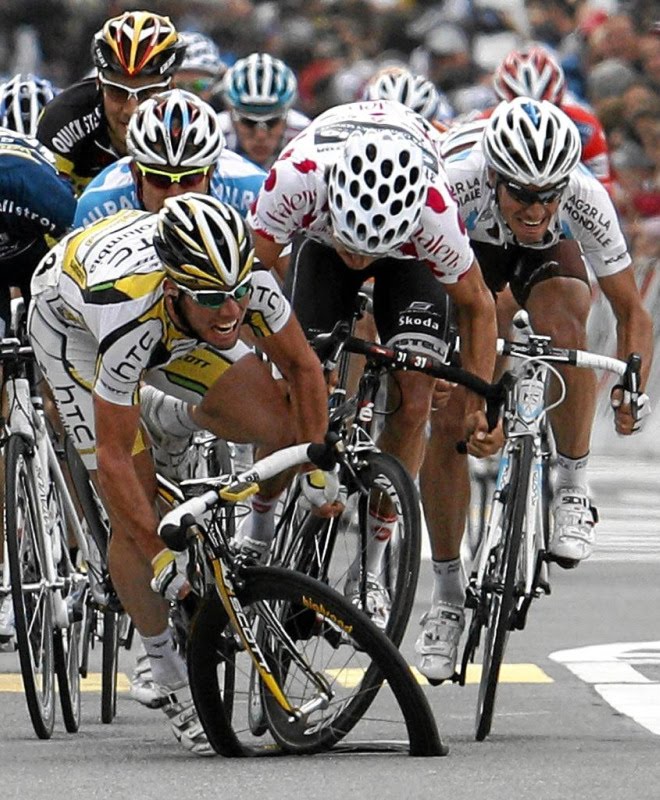
An object in motion tends to stay in motion with the same velocity unless acted upon by an unbalanced force. Unbalance can easily come in the way of a gentle sideways push during a sprint, such as that from Haussler yesterday which planted half a dozen riders including the Boy Racer himself straight down into the Wettingan straightaway like a bunch of toy pieces.


The sideways fall of a cyclist on his bike at rest can be simply modeled as an inverted pendulum, with the center of gravity inscribing a circle from θ=0 to θ=π/2 before hitting the ground. If g is the acceleration due to gravity for earth and r the height of the center of gravity, the acceleration of the fall in the tangential direction is then a function of the angle of fall - gsinθ - and the force is mgsinθ. Integrating acceleration for velocity, you'll find impact velocity at θ=π/2 as v = √(2g/r).

r = 0.8m is not a bad assumption for the center of gravity of a small sprinter like Boy Racer. Plug and chug and you find v = 4.95 m/sec ~ 10 mph!

But in the case of the sprint, Cavendish is not stationary but has an inherent velocity in the direction of the finish line of approx. 45 mph (assumed).  The impact velocity can be considered a resolution of these two orthogonal velocities and what you get is a round about impact velocity of 46 mph or so.

This velocity is reduced to zero by the unyielding bitumen, but due to impact at an angle, its effect is slightly different from a more dangerous free falling vertical collision as the deceleration is spread out over more "seconds".

Looking at the video above, it seems like Cavendish lost most of his velocity in a little less than half a second after hitting flat on the ground on his back. I obtained 200 milliseconds using a stopwatch. Assuming constant deceleration, that would be about 100 m/s2. Which is 100/9.81 ~ 10 g's of impact force spread over the surface area of his back.

Is that a lot of force? Depends whom you talk to and which industry they belong to. But for the Boy Racer, it would really seem he were getting slapped hard on his back by a Sumo wrestler applying 10 times the former's body weight in force, roughly about 6 Kilo newton or 1300 pounds. Only for a fraction of a second, but certainly enough to have shocked him and given some nasty bruises to take home.

Well distributed G-forces can be handled by the body in several times more in magnitude than what the sprint crash has seen (see below). But the human head is slightly more complex and this sensitive system does not tolerate very high peak forces, especially in the rotational sense.  I have put a perspective on the peak G forces on a head with helmet before. You should also read about Head Injury Criterion. Ride safe.

Survivable abrupt positive +g impact. Source.


Strength of vertebrae and inter-vertebral discs in impact. Source.


*  *  *

Monday, June 7, 2010

Speedplay Light Action Platformer Failure


One of the tricky aspects to catch in product design is the amount of true value in it between its stages of evolution. Sometimes, last year's model that you bought could have negligible difference in it as opposed to this year's. Its marketing might say its improved, with a new recipe, new look, new shape and so on and in the end, you would probably pay a premium for it as well, all for the same exact thing.

On the other hand, as a credit to product design, it could also be that last year's model could be insufficient for use compared to the current year's release. Dangerous too. So is this really a credit if people are still using last year's product?

Subsystem design is very dependent on the performance of the parent system.  Today's illustration is a case in point.

Speedplay's marketing line for the "Platformer" brand of pedal adapters is this : "The innovative Speedplay Platformer is a user-friendly, tool-free platform cover for Zero and Light Action pedals. The Platformer makes it easy to convert from clipless pedals to platforms for riding with street shoes."

But reality is different. Last year's clear "Light Action" pedal adapters are really light action, apparently.  As the internet will show, quite a number of people are disappointed with the quality of material used in its design. Durability issues notwithstanding, riding your bike with one of these installed could be a danger just waiting to happen

Among the disgruntled is an individual (who doesn't wish to be named) whose adapters broke just as he was pulling out of a traffic light last summer. Casual riding wasn't light enough for Platformers. The plastic adapter on his right pedal broke catastrophically with an audible snap. Because of little warning, he lost his balance very quickly and ended up crashing on his tailbone and elbow, right in the middle of a road during rush hour traffic. A crucial red light to one side gave him enough time to get back up in pain, pick up the pieces and vacate the road.


Thanks to light action pedal adapters, he is in miserable condition today. Because a fractured coccyx is an injury with no form of available treatment other than time, five months later he still is in immense pain on a daily basis and can’t sit for more than an hour without feeling discomfort. He calls the sensation "intensely searing". For the weekend racer and an enthusiastic bike geek that he is, this is not exactly the good life.

The gravity of the injury and the possibility that someone else could be hurt in similar fashion made him contact Speedplay on many occasions. To make sure this wasn't some freak event, he even installed a set of the old Platformers on his girlfriend's bike as well. The product lasted approximately 16 minutes before they cracked. Some insults are better off when they come with forewarning. This one was even recorded on video by him.

Speedplay took back his pedals for inspection and has stuck by the quality of their brand. They chose to deny his theories of why they broke and didn't feel much need to return them back to him. They have claimed no responsibility for his injuries and other damaged personal articles. The user has now fixed a date with a Small Claims Court to settle the matter in the interest of full disclosure. He has also had a meeting with the Consumer Product Safety Commission.

Interestingly enough, this year's design, with the new "recipe" doesn't seem to have had as many problems since it does not use the same plastic clamshell (see right). The user ordered a pair from Competitive Cyclist, rode them on his girlfriend's spin bike for 50 minutes (the approximate lifespan of the broken ones) and they seemed to hold up just fine.

I suppose somewhere, someone found out the trouble with the old pair, fixed it, moved on. Meanwhile, old units are still being used by riders.


A Plausible Theory

The concept behind the Speedplay Platformer is to allow the user the option of riding a bicycle equipped with Speedplay brand pedals without having to wear dedicated cycling specific shoes. By creating a larger, stable platform around the pedal, Speedplay Platformers, allow the user to ride in “regular shoes."

A set of Speedplay Platformers consists of six pieces. A complete, individual unit is comprised of two seemingly identical pieces of clear plastic. The difference between the two pieces is found on the “inside” where four tabs fit together in a male/female manner. A metal retaining clip slides through these tabs and locks the Platformer in place around the Speedplay pedal.

Because of this design and the fact that the Platformer is molded to be compatible with only one specific type of pedal, it is virtually impossible for the Platformers to be installed incorrectly. They are either locked in place or they aren’t and this is very obvious to the user. To remove a Platformer, a key, coin, or screwdriver is used to remove the metal retaining clip by sliding the clip from the Platformer. The edge of each Platformer is concaved to facilitate the easy removal of the retaining clip.

At the time the user tried the product, he was 210 pounds and stood a height of 6'1". While this isn't typical of your featherweight climbing maestro, he told me that he's never broken any products before and he's always careful with cycling equipment.

Now clipping in and clipping out of Speedplay pedals cause substantial wear on these high performance pedals as most of us have learned. The right pedal, more so due to clipping bias in start-stops. The user's had between 3000-4000 miles of usage on them. For most people, this is a season's worth of use.

This leads to a plausible theory for why the pedals failed. He wrote to me :

My theory for why they broke is because design of the Platformer didn't take into account worn pedals as they are molded around a brand new set of pedals. Since the pedals I was using were worn down, there was some open space between the Platformer and the pedal itself which lead to much more stress on the Platformer particularly on the "outside." 

The following two images show a  3.2% reduction in right side pedal dimension between a brand new and the user's old one.


New right pedal

Used right pedal

The following image, of the used left side pedal, shows a 1% difference in pedal dimensions when compared to the right side pedal. This shows that the right pedal wears more due to clipping bias.


Please be aware of this problem and report any of your personal mis-happenings in the comments section. If you also wish to offer any kind words of advice to the user with regards to a broken tailbone, please share your thoughts.


*  *  *

Monday, December 21, 2009

Safety Moment : Crashing & Breaking Your C1 Vertebra


When I hear of amazing tales of bicycling injuries and recoveries, I always think 'wow, do some folks have a disproportionate amount of lucky stars stashed somewhere in their basement?' Maybe that's why I don't have so much luck. Could others may have more than me?'

Lucky stars it is as today's mind blowing story comes all the way from Florida.

Sandy Scott is a champion Master racer from Florida and well known in cycling circles. He's an aeronautical engineer by schooling and worked as an airline pilot for many years. He also had a stand as a motorcycle cop for a period of time. Today in retired life, his interests are varied from tattoo modeling, to fishing, or from photography to writing for the Florida Racing Magazine. Somewhere along in there, he also manages devote a serious amount of time to training in order to win local bike races.

In Oct 2005, Sandy was racing toward his goal of winning the Florida Senior Games time trials when he was involved in a horrible accident. Keep in mind that time trial bikes are not designed to be very maneuverable. To avoid a person who stepped in front of his bike during the 10K time trial, he swerved suddenly, sending him flying over the handlebars and landing headfirst on the pavement.

Post crash, one witness told him that his rear disk wheel had gone completely airborne after he swerved. Another remarked that his front wheel had been turned 90 degrees to the path of the bike before he went flying over the bars. Whatever it was that caused the crash, Sandy recalls that the one thing that probably saved his life was his Louis Garneau helmet, that split right from the top.

After the incident, he temporarily lost his memory and didn't even remember racing his bike. Two days after he was admitted to hospital, an orthopedic spine surgeon took a look at his CT scans and MRIs and admitted with difficulty that he had one of the rarest and most fatal of all neck fractures - a C1 breakage. This is a type of injury where many residual deaths occur even after treatment because the breathing pipe work is usually situated around the fracture area and victims are often found unable to breathe a little too late.

Anyway, the surgeon told him that their options would be to try and fuse the C1 to the base of the skull or fuse it to the C2 vertebra. Sandy mulled it over. The outcome of the operation would be that he would lose 50% of his neck mobility. He wasn't ready to compromise something like that for bike racing. He chose not to have surgery!! But the resilience of the human body was somehow with him after that ballsy decision. 9 months later, a CAT scan revealed that the 2mm gap in his C1 fracture had somehow miraculously healed!

Now, 18 months later, the 66-year-old has made a tremendous comeback. In December of 2009, he came back and won the Florida State 20K Road Race Championship. He now rides his bike 20 hours a week, trains in the gym and still kicks butt at the local circuit.

Here's a snippet of Sandy's mail to me. He describes a little of his treatment process for those who are interested in the medical tidbits of such cases :
"They immediately fitted me with a hard brace which I wore for the next 5 months. I started immediately training 70 minutes a day on my trainer. I wanted to win a state championship and I was not about to lose my conditioning over even a broken neck. Ultimately, it was thought that the fracture was going to be a non union and the physician released me with the admonition that if I fell, I could die. I still rode with the fastest group in town with a fractured neck and one day an accident happened in front of me where a bike came flying through the air towards me, and I thought, "Oh, no, this is it." It hit me hard on the leg and opened a deep cut. I managed to stay upright.

It ultimately healed in 9 months, and I commenced regular physical therapy to regain my mobility. 14 hours total. In the piece that I sent you I relate meeting of a local chiropractor on the road who knew my story and told me he could help me. At that point, I could not ride my time trial bicycle in that I could not lift my head high enough to see where I was going. Two day a week treatments for a couple of months allowed me to finally be able to ride that TT bike, and months later, I was riding it almost comfortably.

My case was so unique that Dr. Weinstein, the spinal surgeon I found when I refused to have my neck fused as recommended by my first physician, presented my case to a large group of Orthopedic & Neuro Surgeons and Radiologists. My physical therapist thought the case was so amazing, she presented my case at a big convention of physical therapists in Las Vegas. Many of these people have never even seen a C1 fracture in their practices."

Wanting to tell about his injury and how he recovered, trained and won 13 races after his comeback, he co-authored a book titled "From Broken Neck To Broken Records". For those of you in his age category and anyone looking for motivation, the book will be an inspiring read.

Additionally, there is a radio interview at Growing Bolder. The hosts discuss with him about his long road to recovery, including his controversial decision to forgo surgery.

Its an honest and revealing talk from someone who probably wouldn't be alive today if it weren't for some serious luck, some great doctors, and a no-questions-asked winning mindset. And according to his own admission, he probably wouldn't have that mindset if it weren't for the helmet he wore. Little things add up and make a huge difference.


* * *

Tuesday, December 15, 2009

Engineering Cycling Prosthesis For Amputees


It can be easy to forget that physically challenged people often have normal or sometimes, extraordinary cardiovascular and respiratory parameters. The only specialty is that they are deficient in normal motive functions, which is where their disability even becomes apparent. Society can help create devices for them with the help of which they can move and do things like normal people, using less of their own energy. This can go a long way in bringing the best out of these people.

Considering the rate at which technology is leapfrogging these days, athletes like Oscar Pistorius are very well capable of outstanding performances and giving others a run for their money, regardless of the event. You'd think there must be a good reason why we have the Paralympics and more than 20 major events under it.

Making custom prosthesis for such people fascinates me as a truly purposeful and noble engineering endeavor. The question of making things inclusive to the disabled trickles down from sports to normal transportation and recreation. Why must physically challenged people not be able to ride a bike like others? I can't think of any valid reason. And if they can, are there better ways to connect such individuals to the bicycle to give them a stress-free experience?

Four fundamental aspects underlie the above engineering task :

1. Clinical Requirement : Engineers first must understand the clinical condition for which they are making the device. What is the receiver's deficiency? What is his health condition, height and weight?

2. Functional Requirement :
What is the function of the device? Where will it be applied?

3. Bio mechanical Requirement :
What is the biomechanics of the device when installed into the receiver's body, given a choice of coupling? What are the stresses, forces, energy conditions?

4. Cosmetics : Does it look acceptable? Like anything else, individual preference of a product often hinges on how it looks and the psychological impact it has on the user.

These days, assisting devices use state of the art technology with much importance given to the materials side of things for safety and injury prevention. Devices now use carbon fiber for strength and bio compatible items like titanium bolts for socket attachment. Advanced manufacturing schemes are employed to produce the tight tolerances needed as one of the main aims can be to try and restore proper symmetry to an asymmetric body. In the middle of all this, attempts are made to even integrate wireless electronics into the prosthesis.

Below are two examples outlining the kind of technology involved.

TWO EXAMPLES


1. BELOW THE KNEE PROSTHESIS FOR JODY CUNDY

While the aim of prosthesis to create something that matches the mechanical properties of the missing limb, it may not necessarily look like a normal limb. As an illustration, the image at the beginning of this post shows a bespoke prosthetic leg designed by Össur for UK track cycling star, Jody Cundy. Össur is a company based in Iceland and is a global leader in non-invasive orthopedics.

Jody is an amputee who lost his leg due to a deformation condition when he was three. Össur is the same company that made Oscar Pistorius' Cheetah running blades and now has helped made Jody one of the fastest track cyclists in Great Britain by designing a leg out of carbon fiber weighing a mere 600 grams.

Jody approached Össur prior to the Beijing Olympics and asked them if they would be interested in making him a custom cycling leg to compete on. They jumped at the challenge and came up with the leg that he won double gold on in Beijing and the recent world championships.

Iceross X5 Seal provides socket sealing to Jody's residual limb. Casting and donning instructions are can be read here.

The design was kept simple, using what is called a suction socket (vacuum suspension) featuring a Össur X5 seal in liner. Advanced textiles improve durability and elasticity, and adhesion is upped by 25%. Instead of a foot attached to the base, there's a shaped piece of carbon which is moulded into the socket and finished off with a cycling cleat attached to the bottom. The cleat is a standard Shimano SPD-SL to engage with the pedals. Also observe that it is in the same place it would be if Jody was wearing a footed leg with a cycling shoe, so he doesn't create any issues with the bio mechanics of the real part of his leg. Finally, the entire product was given an aerodynamic profile for drag reduction.

In this interview given to BBC, Jody shows off his custom made leg. Clicking on it will lead you to the BBC link. [ Do get back here and finish off the read :) ]


2. ABOVE THE KNEE BIONICS FOR RUDY GARCIA-TOLSON

I'm a huge fan of the Kona Ironman in Hawaii. What truly amazed me this year was the spirit of a double above-the-knee amputee named Rudy Garcia-Tolson from California. Just 21 years of age, he made history by becoming the first individual with such a condition to finish the 2009 Ford Ironman. For those who are not familiar with this spectacular athletic event, that's 2.4 miles of swimming, 112 miles of time trialling and a full blown 26 mile marathon all in sequence without a break.

Rudy is able to dream and achieve in large part because of the technologies now available in prosthesis. He uses precisely selected feet from Össur to meet each activity’s needs: the Flex-Run® for track because of its flexibility and light weight and a specially made flex foot feet (see right) . He was also one of the first bilateral amputees to go bionic with two Rheo Knees. These are also Rudy's everyday, everywhere walking legs that allow him to multi-task and do the things people normally do.

Rudy has two Rheo knees, the world's first micro-processor swing and stance knee system engineered by Össur. Embedded artificial intelligence learns how the user walks and runs, and responds immediately to changes in terrain, load and speed. The knee comes with a PDA that communicates wireless to the knee via bluetooth. Click here for a technical manual.


But while all this technology sounds well and good, top level competitions are merciless in terms of rules and regulations. I guess the reasons could be many why a talented athlete such as Rudy missed the Ironman's bike leg cut-off time of 5:30 pm by just 8 minutes!

But note that I sat through the whole online recording of the Ironman by Universal Sports. Being a fan of Rudy, I was looking out for his performance. While doing so, one of the things I immediately spotted was Rudy's obvious difficulty in engaging the cleats under his artifical feet onto his bike's pedals. This was after he emerged out of the swim to get ready for the 112 mile bike leg.

While the video I recorded below certainly may not account for 8 minutes, it nevertheless shows how time can be lost when a design doesn't necessarily work as planned. It is challenging.


ADDITIONAL READING AND RESOURCES :

Össur Homepage
Driven By Design : The Science Of The Paralympics
Guardian : Prosthetics Don't Give Sprinters Unfair Advantage,Research Suggests
Rudy Garcia-Tolson : Profile
Jody Cundy : World & Paralympic Champion Official Website


* * *

Thursday, October 15, 2009

Analysis Of The Bicycle Endo


The endo, short for end-over or end-over-end, is a type of pitch over crash where the cyclist goes over the handlebars, the weight offset of which causes an inertial moment to act about the front wheel resulting in rear portion of the bicycle to flip in the air above and behind him.

Usually, the cyclist, as a sudden reflex action, yanks out their hands or legs at some point to cushion the impending fall and ends up letting go of handlebar control. Meanwhile, the bicycle is bound to fall either sideways, due to its motion about the steering axis or right on top of the cyclist. In the latter scenario, the saddle or even the rear wheel itself could land on the cyclist's body.

Again, an endo is a crash that could cause injury. It is not a bicycle trick. That one has another name. Its called a 'stoppie' or a 'wheelie'. An endo is caused due to strong front wheel braking or when the bicycle hits a curb, a structure more rigid than the wheel itself. Endos may also occur if the front wheel is loose, i.e, if it is not secured properly to the fork dropouts by the quick release skewers.

In this post, we will cover the "endo parameter", study the relationship between braking force and endo parameter on level ground, outline some common reasons for endos, check out a video analysis of an endo and finally study the relationship between gradient of the road and endo parameter through a literature source.


ENDO PARAMETER

Braking a bicycle naturally upsets equilibrium and transfers weight to the front wheel. With a stark increase in the overall braking force, the load on the rear wheel approaches zero, after which the rear wheel will start to lift off the ground. Hard braking may stop the bicycle but Newton's first law reigns supreme as the cyclist's body continues in motion in the headed direction. This rider motion has some momentum. If not self-controlled, the rider will flip over the handlebars and the bicycle will pitch-over as well. What results is the endo.

It turns out that while outrageous situations cannot be helped, some factor of safety from bicycle design and rider positioning skill can provide for a cushion against pitch-over tendency in the above mentioned situations.

I'll call my main parameter of interest the pitch-over parameter (or endo parameter for lack of a better word) - A/H - as can be seen in the diagram below :

Fig 1 : Free Body diagram of a bicycle-rider system just at pitch-over. Now you may be able to appreciate from geometry and c.o.g as to why recumbents and tandems are stable in pitch-over. O is the point signifying the contact point of the front wheel with the ground.

TERMS :

W = combined rider-bicycle weight
Wf = normal load on front wheel
Wr = normal load on rear wheel
Ff = braking force at front wheel
Fr = braking force at rear wheel
Fb = braking reaction (mass times deceleration)
L = wheelbase
A = location of center of gravity (c.o.g) aft of front wheel
B = location of c.o.g forward of rear wheel
H = height of c.o.g

The endo parameter, A/H (a ratio), in the combined bicycle-rider system should be large enough to avoid front pitch-over. Obviously the vertical height, H, of the center of gravity (c.o.g) and the location of the c.o.g aft of the front wheel, A, are going to vary with variation in rider's weight, height and sitting position.

This highlights why its important to get a proper bike fit for the type of bicycle you wish to ride. Its not just a question about comfort. Its also a question about safety. Enlarged riders who overwhelm miniature bikes not made for their size will quickly find out what they're doing wrong. All they have to do is hit the front brakes hard and they're right on target to be turned into human projectiles.

Looking at the free body diagram above, we can deduce that the system is in static equilibrium about the front wheel contact point O if the sum of the moments due to all forces about that point is zero. In other words, rotation is just initiated at :

Fig 2 : Endo parameter relationship to braking force. This also gives us an expression for the braking force at the point of the pitch-over.

From this simple relation for level ground, we see that endo parameter is equal to the braking force as a percentage of total weight at just about the initiation of the endo. Braking force is a function of the co-efficient of friction at the tire-road interface.

Before the initiation of pitch-over, the braking force-weight ratio is lesser than the endo parameter. Well after the pitch-over has been initiated, the endo parameter falls lesser than the braking force-weight ratio.

We can now infer that making A/H larger is better for safety. Otherwise, a lesser braking force relative to total weight will be sufficient to initiate pitch-over. How? Simply because the braking force-weight ratio catches up with the endo parameter sooner. Oops.

A/H can be fixed to be greater with good bicycle design and proper fit. It can also be superficially made larger by the cyclist while riding by positioning his body rearward (relative to bottom bracket) as the following picture shows :

Fig 3 : A cyclist ducks and shifts his c.o.g rearward to increase his endo parameter

People succumb to pitch-overs because of other factors too. They may not be skilled enough to increase the endo factor, A/H. They also may not be skilled enough to modulate and may tend to hitting the front brakes really hard without realizing that a front brake can cause more deceleration than a rear brake. For comparison, front brakes generate upto 0.5g's of retarding force whereas rear brakes produce a max of 0.1 or 0.2g's. Note that maximum deceleration is limited by the co-efficient of friction between tire and road and the normal load.

You can notice front braking power for some mountain bikes through a speed vs time graph.

Fig 4 : Speed vs Time graphs of MTB's (Courtesy : Beck Forensics)

Obviously, the graphs show that you can bring a bike to a stop faster using the front brakes alone than the rear brakes. Using both brakes is even better for reducing stopping distance even further.


SEQUENCE OF MOTIONS IN AN ENDO


Beck Forensics did an interesting little video analysis of an endo. The following image as well as the snippet below it is taken from a web sampler of their book Bicycle Collision Investigation. It shows the steps involved in an endo before the crash.

A mountain bicyclist traveling at about 22.5 mph (36.2 kph) applies only the front brake. Once the front wheel is nearly locked, the rear wheel starts to lift up. At about 0.20 seconds, the rider really has no chance to recover. At about 0.33 seconds, he releases the brake and prepares his right hand, and then his left hand for landing. The cones are shaped in 25 foot (7.6 m) intervals and the grade is about -2% (descent). (Courtesy : Beck Forensics)


RELATIONSHIP WITH PERCENTAGE GRADIENT OF GROUND

This section is a little more involved. It uses the same analysis techniques shown above to derive a relationship between the "endo parameter" and braking force-weight ratio with the percentage gradient of the ground. You will see that the chances of an endo are more likely on a descent.

The following literature is from one digest of IHPVA (2001), written by a retired engineer named Frederick Matteson. Click on the series of images to zoom the text. Alternatively, you can also read the paper here.

Enjoy!

Page 1 : Click to zoom

Page 2 : Click to zoom

Page 3 : Click to zoom


ADDITIONAL READING :


Budbrake : Proportional Brake Control For Safer Bike Stops
Dynamic Stability Of Bicycle Design : Part 1
Dynamic Stability Of Bicycle Design : Part 2
Dynamic Stability Of Bicycle Design : Part 3
Dynamic Stability Of Bicycle Design : Part 4


* * *

Friday, August 28, 2009

The "Dominant Left Theory" In Bicycling Crashes

This blog brings you new perspectives and interesting ideas in cycling, without any charge. You may pay me back through your continued interest.

Some months back while visiting a good friend of mine, I happened to grab a vintage cycling book off his shelf and flip across its pages. I like the smell of old books. Its like battery acid for the mind of a book enthusiast, just stimulating. In one of its uneventful pages simply titled Appendix, I came across the following words. Read carefully, as the author comes across as completely assured of what he's about to theorize. I'll tell you who wrote this at the end of the quote.
"If you been riding long enough to have some falls, I'll bet that almost every injury has been on the left side of your body. How do I know this? Because its the same for me and many other riders. If you want to find an old bike racer, look for a guy with scars on his left elbow. There seems to be a physiological reason for this and it is very interesting, though it hasn't been formally documented as far as I know. It has to do with the location of the heart, the body's primary organ.

As we know, the heart is to the left of the center in the chest. When the body loses equilibrium, it has a strong tendency to fall toward the heart side. This also explains why most riders find it easier to corner to the left than to the right. And it's why track races go counterclockwise so that all turning is to the left. The reason it feels more natural is that the distance from the heart to the ground is less when turning left than when turning right. Even though track riders often do fall on their right side, this doesn't disprove the theory. It just points out the bike's tendency to slide down the banking.

Cozy Beehive edition of original illustration by Grid Designs

What is the practical value of all this? For one thing it means you may need more practice cornering to the right before it feels as natural as cornering to the left. It may also be wise to wear a protective pad on your left elbow in criteriums, especially if you've injured it before. Should you crash there is a better than even chance you'll land on it again. Keep this "left side" theory in mind and you may find other ways to use it for your benefit. "

The author of those words, documented in the 1985 classic Bicycle Road Racing, was none other than the Polish coach, Eddie B (also known as the father of modern American cycling). Being one of the most respected coaches in history, you'd think he'd make sense with his ideas.

This one is particularly interesting as he's stating that "almost every" injury is to the left side of the body because the body (if you consider it to be an inverted pendulum while on a bike) has a directional falling bias. It is also stated that because this "falling" is easier to the left than the right, cornering towards the left side is as well. Therefore, velodromes are run anticlockwise.

Today, you readers can be fellow mythbusters. I did my part, analyzing some 10-15 real world videos of bicycle crashes. I found no correlations with the statement above and all crashes highly depended on riding conditions. I also counted all my scars and there are more to the right side than the left. I don't believe gravity has a preference for this side or that side.....unless you can take a fresh cadaver, cut the flesh into two equal halves and find out that one side weighs more than the other. Are any of you active in criminal investigations? This whole thing begs me to ask : what side is a dead body more likely to fall towards? (If you have murdered someone, are in jail and use an iPhone to read my blog, let me know....)

So today's question : Is there biologically any reason behind the supposed tendencies to fall towards the left side, or is it just a subconscious reflex action to protect your derailleur and chainring from getting damaged? Ah. Think about that one for the weekend.


ADDITIONAL READING :

We Might As Well Crash

* * *

Friday, August 21, 2009

Safety Moment : Colliding With A Taxi At An Intersection

Jody Leonard after a car-bicycle collision

Good afternoon. Recently, a reader of my blog sent me this moving account of how he came to see the realities of a bicycle collision with an automobile.

Less than a month back, Jody Leonard who works for Deloitte & Touche LLP in Washington DC got into an accident with a taxi at an intersection. I really hope he recovers soon.

Here's a little of what he wrote to me :
"I was finishing up a training ride on a fine evening last July when I was hit by a taxi cab. I was traveling north bound on 15 ST NW toward Constitution Ave and the taxi was going south bound on 15th. This road runs in front of the Washington Monument. At the intersection of 15th and Madison, the driver made a left hand turn onto Madision, the wrong way down a one way street! I was struck by the car as I crossed the intersection at speed with the light. I don't believe he saw me at all.

So long story made short : 9 hours in the Emergency Room, cracked ribs, fractured nose, lacerations, abrasions, etc. but no head trauma as I was wearing a helmet. The driver, meanwhile, was issued a ticket by the US Park Police for an illegal left hand turn.

The Doctor estimates about 4 weeks for everything to start feeling normal again. The cab driver remained on the scene, but it was the many bystanders who came to my aid. This happened in front of the Washington Monument at the tail end of the DC rush hour and park police and EMTs were on the scene in less than 5 minutes. I was very lucky in that respect.

As for liability, in my mind the driver was clearly at fault, but accidents involving taxi cabs in the District are historically hard to deal with. So I took the advice of Bob Mionskie - former Velo News legal columnist - and hired an attorney. By the way, taxi's in DC are only required to carry the minimum amounts of insurance coverage, I really don't understand this since commercial trucks must carry at least a million dollars of insurance, and they don't ferry people around!

The worst part of all of this is my bike is toast! The pictures are deceiving since the entire frame is torqued. Both tires were blown out from the impact and my local shop tells me that the rims (Mavic Ksyrium Elites) are not bent, yet they tell me the wheels are so far out of true and tension that they cannot be salvaged. I'm wondering how this happened? So it looks like I'm out a frame and wheels, a drag since I love that wheel set!

The road back to 100% fitness has been very difficult, but I think I'm getting there. I believe it is important that people take away two messages from what happened to me. They are :

1. No matter how defensively you ride, there is always the possibility of another person's inattention and carelessness, both of which have the potential to cause great harm.

2. Always wear a helmet. I know the last causes consternation among a few who are vehemently against it, but I am certain that I would have had serious brain trauma. If it wasn't for the helmet, the crack would have been on my skull instead of the foam."

Helmet Front

Helmet Left Side Exterior

Helmet Left Side Interior

Interior Crack In Fresh Light

A torqued 7005 series Aluminum bike, much useless now


Other safety moments can be accessed here. If you have an interesting experience of your own to share, please write to me.


ADDITIONAL READING :


Deceleration And Force Of A Helmeted Head Impact

John S. Allen : Riding Through Intersections (Chapter 3 From The Online Book 'Bicycling Street Smarts')

* * *

Tuesday, July 21, 2009

Was It Jens Voigt's Steerer Tube? [NOPE]

Photo Courtesy : Graham Watson

Rumors are flying out left and right that the certain "something in the road" that caused Jens Voigt to crash on the final descent in today's stage was infact not on the road but on his bike. His steerer tube snapped or so, it seems. I have no clue. Now I have immense respect for Jens as a bike rider and like many around the world, was absolutely horrified at the crash. According to some of the official doctors at the Tour, his main injuries seem to be mostly all around the face. We can't tell for sure what he's broken until the scan results come out from Grenoble, but suffice to say - Jens' Tour is over. Let's focus a moment on what happened to the bike, if that's what caused this mess. Does anyone have any clue? Feed any information you have here. We'd all appreciate it. Any of you in France at the moment? Bonjour!

Here's a video, magnified and played in slow-motion courtesy of Sporza. Seeing this makes you doubt that this crash had anything to do with a bike failure. Just keep your focus on the back wheel and then onto Jens' left hand. Check out how he changes his hand position from the hoods to the drops at precisely the wrong time, when the bike had that short 'bounce'. The time frame of importance is between 0:12-0:18 secs.


3 collective observations from me and people who commented :

1) A distinct 'bounce' of the bike as he rides over two different road surfaces, one possibly old and one new. The bike slides out a fraction of a second after this road demarcation, as it comes over the white road surface marking. Whether the white marking was slippery due to motor oil or wet paint is debatable and not factual at this point. The crash happened on the descent near La Rosière and the weather in these alpine areas do get wet. For example, there's a 40% chance of rain at noon there on Wed, July 22.

2) His left hand momentarily lost contact with the handlebars and his body bounced away from the saddle thus losing two critical points of body-bike contact. How often can you stand on a bike with simply a right hand on the drops?

3) I suspect his right hand, which we cannot see, exerted a force on the bars causing the wheel to turn leftward and completely slide out. I think what Jens was trying to do when the bike bounced was to get to the drops as soon as possible to bring the bike to stability. It didn't happen the way he wanted it.


UPDATE :

The most clear picture of the bike's front end yet. Thanks to Luc and others for the pic. Handlebars are intact. Steerer tube ok, yes because the wheel and fork are still attached. Jens does not look good. Right cheekbone fracture and concussion. But no other fatal injuries. Jens is going to love it when he gets up from that hospital bed and reads this.


* * *