* * *
Showing posts with label Interviews. Show all posts
Showing posts with label Interviews. Show all posts
Tuesday, June 22, 2010
Cadel Evans And His Book 'Close to Flying'
I can't believe this was on Youtube and it garnered just 400 views. Here it is again, ABC Radio's interview with a fantastic athlete. (Recall I wrote before on how both his power to weight ratio and VO2 max were greater than Armstrong's when both were at their peak). His new book sells for 70 dollars and change on Amazon. I hear he's a good cook so there better be some tasty recipes in there for that price.

Monday, March 15, 2010
Jobst Brandt : Part IV
Continued from Part III.
Thank you for patiently waiting to read Part IV of this exciting and important interview. In this installment, I asked Jobst to tell us more about his career path at Porsche and Avocet. The discussion then flows into his unique bicycling interests. Why does Jobst have only one bike? Why doesn't he believe in cycling races? What does he love best about Europe? You have lots of material to read below!
17. We discussed your engineering career in brief but a complaint was that I didn't burrow into specifics. Firstly, my readers and I are very interested in knowing how you landed a job at Porsche. Could you please elaborate on the nature of the work you had there?
JB : Sure. I was stationed in Germany (Aschaffenburg) near Frankfurt in the US Army Corps of Engineers and wanted to buy a car because all I had was my bicycle as transportation. I found that I could buy a 356 Porsche at a reasonable price and did so. In that pursuit I reviewed the owner's manual and was told most of it came out of the factory shop manual, that I also examined.
The translation from German to English was poor and in some places incorrect so I dropped in on the Porsche plant in Stuttgart-Zuffenhausen after I got out of the Army and was on my way south to visit my bicycling friends in Florence. I proposed to their personnel manager that I go to work there and with my knowledge of German and English along with my facility with automobile jargon in English, I could do the manual a service.
I was hired to come to work in the fall and did a good job in translation, a version that was recognized as better than what they had. When that job was done, I asked to be transferred to engineering and was assigned to the chassis, brakes and steering division. When I got there, the project leader felt he had too many people and transferred me to Special Products (the racing department) that was just being started.
As I started design work, more and more of the car was transferred to my drafting board and I did the layouts for the chassis, wheel suspension, brakes, steering and transmission. I got along fine in that team and stayed with it until the car won the Belgian GP and Mr. Porsche said it was too expensive. So when he had achieved what he wanted, that racing department was dissolved. I transferred back to the production car division and designed the steering and front suspension.
18. Looking back at Porsche now, what lessons did you learn? Would you drive a Porsche if you had the money to afford one?
JB : From my work there, I discovered why one should not build rear engined cars, air cooled engines and torsion bar suspensions. That Porsche persisted in that design was unfortunate and you see they gave up on air cooling when it died everywhere else in the industry. I wrote for Wikipedia why we ever had air cooled engines in the first place but the Porsche faithful deleted most of that essay, as you can read at Wiki. The "Why" part of that thread is slightly what I wrote but has been diluted.
19. Interesting! So again, would you buy a Porsche or not? How about a Porsche instead of a bicycle? That's a trick question.
JB : Today's Porsche is more a show piece with allusions to great handling and power, but it remains only a symbol with little practical value, much like a Corvette. These cars are mainly image with little real significance.
Ever since returning the the US from Germany, I have driven one make of a station wagon or another. They have served me well and I have transported many bicycles to interesting ride locations. I don't think you can make a real parallel of driving a car and riding a bicycle.
20. Porsche was one of the many places you worked at. You also worked for Avocet. I understand you were a tire designer, is that correct? How did your hand play a role in better designs there?
JB : When the Hoffacker brothers started Avocet, I came up with the name and the logo, which I had as my linoleum block Christmas card for 1973. I've carved a linoleum block for many years, something I learned from my father. The subjects are many - birds, machinery (RR locos), the Locher dual side engagement cog wheel and the Stelvio National Parks logo.
I saw Avocet as a way of getting some bicycle features I couldn't get elsewhere. The Altimeter was an important one for me because it's logic has a good patent that is essential to accumulate climb, something others with altimeters cannot do correctly because they have no hysteresis that ignores small dips in roads or barometric fluctuations. I suspect most of them are not aware of these problems and never think of adopting that patented concept. It took me a while to explain it to Avocet engineers making the hardware and software.
I also wanted slicks, recalling how well our Clement tubulars cornered on wet and dry without miniature car treads that do nothing. Avocet recognized the advantage and made the best slicks ever. To assure riders that one can corner on them, I had a picture taken with me cornering hard. They also had the lowest rolling resistance when they were built by IRC. IRC no longer makes bicycle tires.
 Photo showing Jobst Brandt testing a pair of Avocet tires.
21. Let's talk bicycles. You've often been photographed with a tall and yellow steel bike. Infact, I have not seen any other bikes associated with you. Would you tell us more about it?
JB : When my Cinelli got old and developed cracks from riding Campagnolo Record hubs with a long overhung axle on the right end, my good friend and great riding companion Peter Johnson built me a new frame. Earlier, Tom Ritchey had built me a bicycle that I had wrecked by descending into a cross-drain on a forest descent, so Peter built the bicycle you see in photographs. It has an oversized downtube and is fillet brazed. It needs a paint job now that it is about 20 years old.
The reason for yellow is that cracks can be seen better than on most other colors than white. I realized that getting rid of the crack generators was better than a good color. That's why I am riding Shimano 7-speed hubs that have no axle overhang as Campagnolo hubs. Peter also built me a new fork with a threadless steer tube for which Ritchey gave me the stem.
21. So you have no other bikes apart from the yellow one?
JB : No. I never had more then one bicycle mainly because I maintain it and can ride only one. That's my main problem with the bicycle faithful. They collect these religious symbols and treat them as near human icons.
22. Typically, how much would you ride your bike in a year when you were young?
JB : I have always ridden about 10,000 miles per year and probably still do, now that I am retired. That comes to about 200+ miles per week. After a recent car incident that caused a couple of broken ribs, followed by much rain (daily) I missed about four weeks of riding and am getting back in shape now. That isn't easy for an old man.
23. I'm sorry about the accident but for a person of your cycling calibre, you should be able to ease into cycling without problems.
JB : I don't recall winters being so wet and cold but that slows me down these days.
24. As a well-respected engineer and cycling enthusiast, what do you think of UCI's decisions to ban certain bike designs? Do you think its healthy for the sport or are you one who supports tradition?
JB : That is a mis-characterization of racing rules. The rules are there to attempt to make a "level playing field", not to prevent technical advances. The HPVA is there for innovative two wheel designs, most of which violate the concept of preventing mechanical advantage to win in competition rather than by athletic ability. As I mentioned, I was aware of that in my younger days when I was faster than all others on the road through ability rather than a special bicycle.
I don't support tradition, in the sense of freezing technical advances to an older time. I think advancements can be made but not in "space age" technology for bicycles.
25. Do you believe that bicycle design has reached a state of saturation, if you will allow me to use that word? If not, where could some more genuine improvements be made according to you?
JB : It is not bicycle (technical) but rather in styling design where the effort lies. Saturation only appears to those who don't understand what the problems are. Classically, the threadless steertube was a great leap forward and has not been accepted as such by most of the contributors to rec.bike.tech. There is where saturation lies.
26. Do you have time to follow cycling races and all the doping drama? Do you have any opinions on Lance Armstrong's uncertain comeback, or on the talented Alberto Contador?
JB : I don't like professional sports and don't follow them, other than having seen the GdI or TdF on my bicycle trips in the Alps. That goes for team sports, skiing, and other "my aerobic abilities are greater than yours" type competition. No one benefits from that in contrast to demonstrations of skill as in music, painting, sculpture, and ballet. Art is full of pleasant venues. This other stuff is just a bunch of gladiators. Just look at the bodies of US football players.
27. Did you race back in the day? Were there any wins or accolades?
JB : Only a couple of time trials. I decided that massed start races were full of hazards and some trickery. I only raced a couple of times before I decided to concentrate on touring.
 Dated photo showing Jobst standing proudly with his friend at the peak of the Penserjoch. This is a 1950 m foot climb near the Italian-Austrian border.
28. Touring is one what I wanted to concentrate this discussion on. Your Alpine tours are stuff of legend. I spend some time reading your colorful tour reports and loved the prose. It seems to me you have made an enjoyable annual tradition out of this. What got you interested in the Alps from a cycling standpoint?
JB : My father was a tourist as I am and though he did his trips by car with the family, it was not planned with motel reservations but rather "eine fahrt ins Blaue" as it is called in German - "a trip into the wild blue yonder". When he took his appointment to Gen. Lucius Clay to go to Heidelberg, the US economic headquarters, he put us up in civilized central Switzerland and so doing took us on a car trips over the old and famous mountain passes. I recall these times as a high school youngster vividly as does my older brother. Of course I wanted to see those places again and doing so on a bicycle was a better experience.
29. If you don't mind, tell us about your favorite spots out there?
JB : Pleasant hotels in villages or even solo in the mountains are common in Europe, something that makes it more pleasant. Also, these are family operations with no motel chain in the background. We have similar places in the Sierra and so we choose to stay there.
30. Have you openly supported bicycling advocacy? Also, what message do you have for those folks who desire to adopt bicycling as a mode of transport?
JB : I think my advocacy should be evident from my ride reports. These reports are not filled with arduous hardships and suffering, but rather the beauty of the places and people I encounter. I think that is what life is about and many people have followed these trips. As I ride here and in the Alps, I am often greeted by name from people I don't know. I find personal notes taped to the poster of me at the cliff in the Refugio Bonetta.
Don't cycle unless you are a good physical specimen, otherwise its a drag and no fun. Also, get off the million dollar non steel bicycle.
Part V to come soon...
Thank you for patiently waiting to read Part IV of this exciting and important interview. In this installment, I asked Jobst to tell us more about his career path at Porsche and Avocet. The discussion then flows into his unique bicycling interests. Why does Jobst have only one bike? Why doesn't he believe in cycling races? What does he love best about Europe? You have lots of material to read below!
17. We discussed your engineering career in brief but a complaint was that I didn't burrow into specifics. Firstly, my readers and I are very interested in knowing how you landed a job at Porsche. Could you please elaborate on the nature of the work you had there?
JB : Sure. I was stationed in Germany (Aschaffenburg) near Frankfurt in the US Army Corps of Engineers and wanted to buy a car because all I had was my bicycle as transportation. I found that I could buy a 356 Porsche at a reasonable price and did so. In that pursuit I reviewed the owner's manual and was told most of it came out of the factory shop manual, that I also examined.
The translation from German to English was poor and in some places incorrect so I dropped in on the Porsche plant in Stuttgart-Zuffenhausen after I got out of the Army and was on my way south to visit my bicycling friends in Florence. I proposed to their personnel manager that I go to work there and with my knowledge of German and English along with my facility with automobile jargon in English, I could do the manual a service.
I was hired to come to work in the fall and did a good job in translation, a version that was recognized as better than what they had. When that job was done, I asked to be transferred to engineering and was assigned to the chassis, brakes and steering division. When I got there, the project leader felt he had too many people and transferred me to Special Products (the racing department) that was just being started.
As I started design work, more and more of the car was transferred to my drafting board and I did the layouts for the chassis, wheel suspension, brakes, steering and transmission. I got along fine in that team and stayed with it until the car won the Belgian GP and Mr. Porsche said it was too expensive. So when he had achieved what he wanted, that racing department was dissolved. I transferred back to the production car division and designed the steering and front suspension.
18. Looking back at Porsche now, what lessons did you learn? Would you drive a Porsche if you had the money to afford one?
JB : From my work there, I discovered why one should not build rear engined cars, air cooled engines and torsion bar suspensions. That Porsche persisted in that design was unfortunate and you see they gave up on air cooling when it died everywhere else in the industry. I wrote for Wikipedia why we ever had air cooled engines in the first place but the Porsche faithful deleted most of that essay, as you can read at Wiki. The "Why" part of that thread is slightly what I wrote but has been diluted.
19. Interesting! So again, would you buy a Porsche or not? How about a Porsche instead of a bicycle? That's a trick question.
JB : Today's Porsche is more a show piece with allusions to great handling and power, but it remains only a symbol with little practical value, much like a Corvette. These cars are mainly image with little real significance.
Ever since returning the the US from Germany, I have driven one make of a station wagon or another. They have served me well and I have transported many bicycles to interesting ride locations. I don't think you can make a real parallel of driving a car and riding a bicycle.
20. Porsche was one of the many places you worked at. You also worked for Avocet. I understand you were a tire designer, is that correct? How did your hand play a role in better designs there?
JB : When the Hoffacker brothers started Avocet, I came up with the name and the logo, which I had as my linoleum block Christmas card for 1973. I've carved a linoleum block for many years, something I learned from my father. The subjects are many - birds, machinery (RR locos), the Locher dual side engagement cog wheel and the Stelvio National Parks logo.
I saw Avocet as a way of getting some bicycle features I couldn't get elsewhere. The Altimeter was an important one for me because it's logic has a good patent that is essential to accumulate climb, something others with altimeters cannot do correctly because they have no hysteresis that ignores small dips in roads or barometric fluctuations. I suspect most of them are not aware of these problems and never think of adopting that patented concept. It took me a while to explain it to Avocet engineers making the hardware and software.
I also wanted slicks, recalling how well our Clement tubulars cornered on wet and dry without miniature car treads that do nothing. Avocet recognized the advantage and made the best slicks ever. To assure riders that one can corner on them, I had a picture taken with me cornering hard. They also had the lowest rolling resistance when they were built by IRC. IRC no longer makes bicycle tires.
 Photo showing Jobst Brandt testing a pair of Avocet tires.
21. Let's talk bicycles. You've often been photographed with a tall and yellow steel bike. Infact, I have not seen any other bikes associated with you. Would you tell us more about it?
JB : When my Cinelli got old and developed cracks from riding Campagnolo Record hubs with a long overhung axle on the right end, my good friend and great riding companion Peter Johnson built me a new frame. Earlier, Tom Ritchey had built me a bicycle that I had wrecked by descending into a cross-drain on a forest descent, so Peter built the bicycle you see in photographs. It has an oversized downtube and is fillet brazed. It needs a paint job now that it is about 20 years old.
The reason for yellow is that cracks can be seen better than on most other colors than white. I realized that getting rid of the crack generators was better than a good color. That's why I am riding Shimano 7-speed hubs that have no axle overhang as Campagnolo hubs. Peter also built me a new fork with a threadless steer tube for which Ritchey gave me the stem.
21. So you have no other bikes apart from the yellow one?
JB : No. I never had more then one bicycle mainly because I maintain it and can ride only one. That's my main problem with the bicycle faithful. They collect these religious symbols and treat them as near human icons.
22. Typically, how much would you ride your bike in a year when you were young?
JB : I have always ridden about 10,000 miles per year and probably still do, now that I am retired. That comes to about 200+ miles per week. After a recent car incident that caused a couple of broken ribs, followed by much rain (daily) I missed about four weeks of riding and am getting back in shape now. That isn't easy for an old man.
23. I'm sorry about the accident but for a person of your cycling calibre, you should be able to ease into cycling without problems.
JB : I don't recall winters being so wet and cold but that slows me down these days.
24. As a well-respected engineer and cycling enthusiast, what do you think of UCI's decisions to ban certain bike designs? Do you think its healthy for the sport or are you one who supports tradition?
JB : That is a mis-characterization of racing rules. The rules are there to attempt to make a "level playing field", not to prevent technical advances. The HPVA is there for innovative two wheel designs, most of which violate the concept of preventing mechanical advantage to win in competition rather than by athletic ability. As I mentioned, I was aware of that in my younger days when I was faster than all others on the road through ability rather than a special bicycle.
I don't support tradition, in the sense of freezing technical advances to an older time. I think advancements can be made but not in "space age" technology for bicycles.
25. Do you believe that bicycle design has reached a state of saturation, if you will allow me to use that word? If not, where could some more genuine improvements be made according to you?
JB : It is not bicycle (technical) but rather in styling design where the effort lies. Saturation only appears to those who don't understand what the problems are. Classically, the threadless steertube was a great leap forward and has not been accepted as such by most of the contributors to rec.bike.tech. There is where saturation lies.
26. Do you have time to follow cycling races and all the doping drama? Do you have any opinions on Lance Armstrong's uncertain comeback, or on the talented Alberto Contador?
JB : I don't like professional sports and don't follow them, other than having seen the GdI or TdF on my bicycle trips in the Alps. That goes for team sports, skiing, and other "my aerobic abilities are greater than yours" type competition. No one benefits from that in contrast to demonstrations of skill as in music, painting, sculpture, and ballet. Art is full of pleasant venues. This other stuff is just a bunch of gladiators. Just look at the bodies of US football players.
27. Did you race back in the day? Were there any wins or accolades?
JB : Only a couple of time trials. I decided that massed start races were full of hazards and some trickery. I only raced a couple of times before I decided to concentrate on touring.
 Dated photo showing Jobst standing proudly with his friend at the peak of the Penserjoch. This is a 1950 m foot climb near the Italian-Austrian border.
28. Touring is one what I wanted to concentrate this discussion on. Your Alpine tours are stuff of legend. I spend some time reading your colorful tour reports and loved the prose. It seems to me you have made an enjoyable annual tradition out of this. What got you interested in the Alps from a cycling standpoint?
JB : My father was a tourist as I am and though he did his trips by car with the family, it was not planned with motel reservations but rather "eine fahrt ins Blaue" as it is called in German - "a trip into the wild blue yonder". When he took his appointment to Gen. Lucius Clay to go to Heidelberg, the US economic headquarters, he put us up in civilized central Switzerland and so doing took us on a car trips over the old and famous mountain passes. I recall these times as a high school youngster vividly as does my older brother. Of course I wanted to see those places again and doing so on a bicycle was a better experience.
29. If you don't mind, tell us about your favorite spots out there?
JB : Pleasant hotels in villages or even solo in the mountains are common in Europe, something that makes it more pleasant. Also, these are family operations with no motel chain in the background. We have similar places in the Sierra and so we choose to stay there.

30. Have you openly supported bicycling advocacy? Also, what message do you have for those folks who desire to adopt bicycling as a mode of transport?
JB : I think my advocacy should be evident from my ride reports. These reports are not filled with arduous hardships and suffering, but rather the beauty of the places and people I encounter. I think that is what life is about and many people have followed these trips. As I ride here and in the Alps, I am often greeted by name from people I don't know. I find personal notes taped to the poster of me at the cliff in the Refugio Bonetta.
Don't cycle unless you are a good physical specimen, otherwise its a drag and no fun. Also, get off the million dollar non steel bicycle.
Part V to come soon...
* * *
I mentioned in the interview that I enjoyed the colorful prose in some sections of Jobst's ride reports. Here's an example I wanted to share with you, sourced from his 2006 journey :
Friday, 14 July (Samedan - Borgomanero, 222km, 1200m)
"We pushed off into a cool sunrise, choosing the urban route through Celerina and St. Moritz (1837m) to get a closeup view of the ritzy hotels, so called after hotelier César Ritz (1850-1918) who invented the genre in Paris. Among other things, we passed the giant aerial tram, the Signalbahn, that connects downtown with ski and hiking area toward Piz Nair (3056m).
Riding west along Lake Silvaplana, past Silvaplana (1815m), at the north ramp of the Julier Pass, the scene was right out of a tourist calendar. Farther on, we rode along the Silsersee, the source of the Inn River, to reach the one sided Maloja Pass (1815m). From here a curvy zigzag but brisk descent took us down the wall of the box canyon to the flat valley above Casaccia (1458m) and on down the valley toward the Italian border at Castasegna and finally Chiavenna (325m).
CONNECTED READINGS :
Jobst Brandt : Part I
Jobst Brandt : Part II
Jobst Brandt : Part III
Jobst Brandt : Part IV
Jobst Brandt : Part V
Friday, 14 July (Samedan - Borgomanero, 222km, 1200m)
"We pushed off into a cool sunrise, choosing the urban route through Celerina and St. Moritz (1837m) to get a closeup view of the ritzy hotels, so called after hotelier César Ritz (1850-1918) who invented the genre in Paris. Among other things, we passed the giant aerial tram, the Signalbahn, that connects downtown with ski and hiking area toward Piz Nair (3056m).
Riding west along Lake Silvaplana, past Silvaplana (1815m), at the north ramp of the Julier Pass, the scene was right out of a tourist calendar. Farther on, we rode along the Silsersee, the source of the Inn River, to reach the one sided Maloja Pass (1815m). From here a curvy zigzag but brisk descent took us down the wall of the box canyon to the flat valley above Casaccia (1458m) and on down the valley toward the Italian border at Castasegna and finally Chiavenna (325m).
We crossed the Mera River to ride along the west side of Lago di Como to appreciate the many unbelievably ornate villas with manicured gardens surrounded by stone walls, fences of fancy ironwork, and neatly trimmed hedges. Sail- and motorboats were sailing on the lake and once in a while a ferry/cruise boat plied its course between the major towns around the lake.
Before I realized it, we had passed through Menaggio where I had planned to turn west to Lago di Lugano to view more villas, but we were doing all right here and continued to the outskirts of Como where we took secondary roads south of Varese to Borgomanero (538m). We found a wonderful hotel with a garden dining atrium at the end of a long cul-de-sac off the busy main street.
We parked our bicycles in the garage and got cleaned up to appear for dinner in our travel finery to enjoy a delicious Italian dinner on this comfortably warm summer evening. During dinner, alpine swifts darted overhead, picking off insects while giving their characteristic modulated chirp as they worked until dusk. After that, bats took over the task. "CONNECTED READINGS :
Jobst Brandt : Part I
Jobst Brandt : Part II
Jobst Brandt : Part III
Jobst Brandt : Part IV
Jobst Brandt : Part V
* * *
Thursday, March 11, 2010
Jobst Brandt : Part III
Continued from Part II
In this section, I press Jobst to talk about his online persona. People have mixed feelings about him. One side has it that he's an interesting person with an immense wealth of knowledge and experience. Another side is always wary of his crusty, irritable personality which they feel can be off-putting and hard to work with. What does he feel about all that? Well, find out.
11. There's the real Jobst Brandt, and then there's the online Jobst Brandt. The latter portion in your claim to fame seals your status as a no-questions-asked guru of bicycling, if you will. I was interested in knowing where all this began. Did someone invite you to compile these words of wisdom and archive them online or was it self-started?
JB : I started writing them long ago to fill voids in mechanical understanding that I perceived. Becoming a guru was from the attacks that responded to my explanations of natural phenomena. The impression probably comes mainly from bikers who believe in their "common knowledge", that is mostly misdirected. They feel they need to defend that position and go on the attack. Just search how many so called engineers insist that my analysis and instructions on the bicycle wheel are all wrong. I'm used to that. It's the story of my engineering career. I hear similar stories from other engineers.
For years, there was just one newsgroup before splitting up into tech, misc, rides, market, etc... Back before it grew out of its pants it was a pleasant place with only rare disagreements. Once the place became noted, the BS artists realized they had a rostrum from which to spread their religion.
12. You also have an almost cruel stance against irrational statements. You are popularly associated with this wise, very experienced man with meticulous attention to detail, but also moody and cranky and perhaps a little myopic to suggestions while sticking to old fashioned advice. Do you agree with some of these views?
JB : I have little patience with people who write anonymously, mainly because their reason (incompetence) for doing so. Well they don't explain why it is "old-fashioned" advice. Much of that comes indirectly from my bicycling that is not racing. That Sierra ride that is on someone's web site is a classic for iconoclasts.
They feel that I am not giving them their due when in fact I don't mention their style that they are trying to claim is the only way. Another earlier point is that I was a faster and stronger rider than most of the locals and that irritated newbies. I am old and slow now but still go on long rides.
13. Coming back to this idea of people having misdirected knowledge, what's your pick for one that you find having to straighten out often?
JB : A classic is that a hub of a bicycle wheel "hangs from the top spokes". That struck me when I first got a high class Cinelli bicycle. I realized that this ignores pre-stressed structures and that most people wouldn't recognize a pre-stressed structure if they ran into it. I once took a train to Budapest solely to see the worlds first significant suspension bridge, the "Chain Bridge":
This bridge was built without suspension cables that Roebling had not yet invented, so all elements were long steel pinned bars. Click on center picture second row and see some of the beautiful structures engineers have built. The last shot in that sequence is the Chain Bridge. I was not disappointed.
14. I'm curious - do you personally know any of these online folks you exchange all this information with?
JB : A few who are pleasant, yes. That's where I found the German (Klaus Schmidt) who assisted me in proof reading the German translation of my book. He once wrote off and on to rec.bicycle, but when it got big and broad and rude, he bailed out. The same seems to have happened to Bruce Hildenbrand whom I mention in one tour report.
15. Which brings me to probably one of most important questions to wrap up. How well did you know Sheldon Brown and could you write a little about your relationship with him?
JB : I got along fine with him and we talked at InterBike for a few years until he said he was coming out my way in the summer to visit his daughter Tova, who was attending UC Santa Cruz. I met him at his motel in Santa Cruz, 65 miles from my house, from which we took a great ride along the coast and up through big redwoods before he descended to Santa Cruz from Summit Road while I rode home. He took the FAQ title page picture of me standing over my bicycle on that ride and I took some good ones of him that I am sure his wife has suitably saved.
 Jobst Brandt and Sheldon Brown in Santa Cruz in 2006. This photo was borrowed from the latter's journal, where he had documented the day's ride with Jobst.
16. He was a renaissance man. Do you feel the cycling world is a little emptier without his presence of mind?
JB : I liked him a lot and found him to be no mechanical dummy. As you may recall, The London Times wrote a glowing obituary after his sudden death that came after the second time he came to Santa Cruz on which he and his wife had a lovely ride around the place. He was already suffering from deterioration but didn't let it take his bicycling away. The next time I saw him he was on an electric three-wheeler at InterBike, no longer able to walk. A great man! As you see, he believed in the stuff I wrote and put it on his web site.
Part IV continued...
* * *
Here, I have dug up two relevant snippets. They contain Jobst's replies to newsgroups folks. In one, he clarifies the loads on the bicycle wheel that appeared difficult to grasp for one gentleman. In the other, he admonishes someone for posting anonymously. Be warned! Never post anonymously if you are writing to Jobst. And while you're at it, avoid smileys and other nonsensical characters too!
Topic : Bicycle Wheel Loading (1999) : Eric Salathe initially wrote : "The Bicycle Wheel is beautifully written, but the persistent lack of acceptance of this idea among its readers, as well documented on this list, shows that the 'wheel stands on its lower spokes' slogan does not accomplish its function."
JB's reply : "I chose not to condescend and state anything other than what is engineering fact, explaining why and how the wheel works. I know that many people have great difficulty visualizing this and I believe that is why the wire spoked wheel remained misunderstood and not analyzed until "the Bicycle Wheel" was published. Previously many authors wrote extensively about what they believed took place. None of these recognized that the top spokes or, for that matter, any other spokes of the wheel were affected by the vertical load except the bottom few in the tire contact zone. That loads only unload spokes was also not understood. When a wheel is overloaded or crashed to destruction, none of its spokes are overloaded (other than possibly being kinked after becoming slack).
I am fairly sure that the whole subject is still a mystery to most people who should understand it. I overhear conversations and see postings here that reveal these misconceptions. Even people who seem to grasp the concept have said as much as "I crashed my wheel and have to get all new spokes". Progress is slow in coming."
Topic : Anonymous Postings (2009) : "Dan O" initially justified to Jobst the unseen value in anonymous postings by writing : "What's in a name? You must assume that any information you make available on the internet will be harvested, stored, and used indefinitely and completely outside your control. This information can be accessible to any and every wacko 'in the world'. The availability of information can even affect the security of other people who might never have chosen to make it publicly available. So it is a sensible basic tenet to not provide unnecessary information to systems outside your own control."
JB's reply : "I suppose you don't take off your dark glasses when introduced to people with whom you exchange thoughts and ideas. That and chewing gum is something one once learned not to do in polite societal encounters. I realize that this forum lost all that about 15 years ago and now we occasionally read about newsgroups that have vanished for the large volume of rude and anonymous postings.
I hope you noticed that the least civil postings come from a raft of secret agents. Even Sheldon Brown had no effect on the genre in his days in spite of his courteous style of asking these writers to sign their work with real names. I guess this is like many other fads that people follow without cause or reason, like wearing dark glasses in all weather and night time too to have the I-spy look."
CONNECTED READINGS :
Jobst Brandt : Part I
Jobst Brandt : Part II
Jobst Brandt : Part III
Jobst Brandt : Part IV
Jobst Brandt : Part V
In this section, I press Jobst to talk about his online persona. People have mixed feelings about him. One side has it that he's an interesting person with an immense wealth of knowledge and experience. Another side is always wary of his crusty, irritable personality which they feel can be off-putting and hard to work with. What does he feel about all that? Well, find out.
11. There's the real Jobst Brandt, and then there's the online Jobst Brandt. The latter portion in your claim to fame seals your status as a no-questions-asked guru of bicycling, if you will. I was interested in knowing where all this began. Did someone invite you to compile these words of wisdom and archive them online or was it self-started?
JB : I started writing them long ago to fill voids in mechanical understanding that I perceived. Becoming a guru was from the attacks that responded to my explanations of natural phenomena. The impression probably comes mainly from bikers who believe in their "common knowledge", that is mostly misdirected. They feel they need to defend that position and go on the attack. Just search how many so called engineers insist that my analysis and instructions on the bicycle wheel are all wrong. I'm used to that. It's the story of my engineering career. I hear similar stories from other engineers.
For years, there was just one newsgroup before splitting up into tech, misc, rides, market, etc... Back before it grew out of its pants it was a pleasant place with only rare disagreements. Once the place became noted, the BS artists realized they had a rostrum from which to spread their religion.
12. You also have an almost cruel stance against irrational statements. You are popularly associated with this wise, very experienced man with meticulous attention to detail, but also moody and cranky and perhaps a little myopic to suggestions while sticking to old fashioned advice. Do you agree with some of these views?
JB : I have little patience with people who write anonymously, mainly because their reason (incompetence) for doing so. Well they don't explain why it is "old-fashioned" advice. Much of that comes indirectly from my bicycling that is not racing. That Sierra ride that is on someone's web site is a classic for iconoclasts.
They feel that I am not giving them their due when in fact I don't mention their style that they are trying to claim is the only way. Another earlier point is that I was a faster and stronger rider than most of the locals and that irritated newbies. I am old and slow now but still go on long rides.
13. Coming back to this idea of people having misdirected knowledge, what's your pick for one that you find having to straighten out often?
JB : A classic is that a hub of a bicycle wheel "hangs from the top spokes". That struck me when I first got a high class Cinelli bicycle. I realized that this ignores pre-stressed structures and that most people wouldn't recognize a pre-stressed structure if they ran into it. I once took a train to Budapest solely to see the worlds first significant suspension bridge, the "Chain Bridge":
This bridge was built without suspension cables that Roebling had not yet invented, so all elements were long steel pinned bars. Click on center picture second row and see some of the beautiful structures engineers have built. The last shot in that sequence is the Chain Bridge. I was not disappointed.
14. I'm curious - do you personally know any of these online folks you exchange all this information with?
JB : A few who are pleasant, yes. That's where I found the German (Klaus Schmidt) who assisted me in proof reading the German translation of my book. He once wrote off and on to rec.bicycle, but when it got big and broad and rude, he bailed out. The same seems to have happened to Bruce Hildenbrand whom I mention in one tour report.
15. Which brings me to probably one of most important questions to wrap up. How well did you know Sheldon Brown and could you write a little about your relationship with him?
JB : I got along fine with him and we talked at InterBike for a few years until he said he was coming out my way in the summer to visit his daughter Tova, who was attending UC Santa Cruz. I met him at his motel in Santa Cruz, 65 miles from my house, from which we took a great ride along the coast and up through big redwoods before he descended to Santa Cruz from Summit Road while I rode home. He took the FAQ title page picture of me standing over my bicycle on that ride and I took some good ones of him that I am sure his wife has suitably saved.
 Jobst Brandt and Sheldon Brown in Santa Cruz in 2006. This photo was borrowed from the latter's journal, where he had documented the day's ride with Jobst.
16. He was a renaissance man. Do you feel the cycling world is a little emptier without his presence of mind?
JB : I liked him a lot and found him to be no mechanical dummy. As you may recall, The London Times wrote a glowing obituary after his sudden death that came after the second time he came to Santa Cruz on which he and his wife had a lovely ride around the place. He was already suffering from deterioration but didn't let it take his bicycling away. The next time I saw him he was on an electric three-wheeler at InterBike, no longer able to walk. A great man! As you see, he believed in the stuff I wrote and put it on his web site.
Part IV continued...
* * *
Here, I have dug up two relevant snippets. They contain Jobst's replies to newsgroups folks. In one, he clarifies the loads on the bicycle wheel that appeared difficult to grasp for one gentleman. In the other, he admonishes someone for posting anonymously. Be warned! Never post anonymously if you are writing to Jobst. And while you're at it, avoid smileys and other nonsensical characters too!
JB's reply : "I chose not to condescend and state anything other than what is engineering fact, explaining why and how the wheel works. I know that many people have great difficulty visualizing this and I believe that is why the wire spoked wheel remained misunderstood and not analyzed until "the Bicycle Wheel" was published. Previously many authors wrote extensively about what they believed took place. None of these recognized that the top spokes or, for that matter, any other spokes of the wheel were affected by the vertical load except the bottom few in the tire contact zone. That loads only unload spokes was also not understood. When a wheel is overloaded or crashed to destruction, none of its spokes are overloaded (other than possibly being kinked after becoming slack).
I am fairly sure that the whole subject is still a mystery to most people who should understand it. I overhear conversations and see postings here that reveal these misconceptions. Even people who seem to grasp the concept have said as much as "I crashed my wheel and have to get all new spokes". Progress is slow in coming."
Topic : Anonymous Postings (2009) : "Dan O" initially justified to Jobst the unseen value in anonymous postings by writing : "What's in a name? You must assume that any information you make available on the internet will be harvested, stored, and used indefinitely and completely outside your control. This information can be accessible to any and every wacko 'in the world'. The availability of information can even affect the security of other people who might never have chosen to make it publicly available. So it is a sensible basic tenet to not provide unnecessary information to systems outside your own control."
JB's reply : "I suppose you don't take off your dark glasses when introduced to people with whom you exchange thoughts and ideas. That and chewing gum is something one once learned not to do in polite societal encounters. I realize that this forum lost all that about 15 years ago and now we occasionally read about newsgroups that have vanished for the large volume of rude and anonymous postings.
I hope you noticed that the least civil postings come from a raft of secret agents. Even Sheldon Brown had no effect on the genre in his days in spite of his courteous style of asking these writers to sign their work with real names. I guess this is like many other fads that people follow without cause or reason, like wearing dark glasses in all weather and night time too to have the I-spy look."
CONNECTED READINGS :
Jobst Brandt : Part I
Jobst Brandt : Part II
Jobst Brandt : Part III
Jobst Brandt : Part IV
Jobst Brandt : Part V
* * *
Tuesday, March 9, 2010
Jobst Brandt : Part II
Continued from Part 1.
Thus began the interview with Jobst Brandt. Note that each of these 'sessions' are appended with some of his interesting writings that I found on the web. I have chosen them carefully not only to stay with the topic, but also to bring to light Brandt's wavelength of thinking that is very unique to him.
Pictures : Standford University. Source.
1. We mostly know the man Jobst Brandt through online articles and a book, but what are the missing links in the story? Firstly, where were you born and was the bicycle a constant in your upbringing?
JB : I was born in NY and moved to Palo Alto in 1938 when my father took a position at Stanford University. I have a BS in Engineering from the same. I started bicycling at age five and found it useful to go to school and to the community center and swimming pool that was more than a mile away. We even did outings to the yacht harbor, five miles away. I was gifted with big lungs and strong legs and so I enjoyed it.
 2. What did you like about mechanical engineering that made you pursue it? Did you always feel math and science was your forte?
JB : I suppose one is born with a preference for music, sculpture, or science in various forms. At preschool age I was always interested in how things worked... mechanically and otherwise. Electronics was not one of them.
3. What were some of the most memorable things you did in your engineering classes at Stanford? Were you involved in extra-curricular activities and such outside classes?
JB : Not much, my interests were in practical things. Railroads and steam engines were a large attraction for their mechanisms and how they worked. The same went for cars that needed much mechanical assistance in my youth.
4. I see. So tell me where this passion for the physics, mechanics and failure of bicycle parts come from anyway?
JB : These are standard failure mechanisms of machinery that I watched with interest starting in my mother's kitchen and our cars and bicycles.
5. Do correct me if I'm off a bit here in reading you. Would you consider yourself frugal? Did you parents ever bring you up this way, cultivating in you the need to be conservative with finances or was it the engineering career that taught you that money and resources are limited, hence design must be based around that.
JB : I think you are jumping to conclusions. As a youth I lived through the days of the second World War in which many things were scarce (due to the "War Effort") so we were careful about what was thrown away or repaired. I don't see a great frugality in my habits, I think they are more in line with not being a conspicuous consumer. I know many bicycle riders who are embarrassed to patch a tire tube because they don't want to be seen as poor people or cheapskates.
6. Have you ever considered teaching?
JB : Yes and no. I seldom have time to develop a routine. Guest speaker is a better venue.
7. Would you kindly share a little about your professional background for my readers? I've read that you've had a stint at some big names such as Porsche, Stanford Linear Accelerator Center, HP, Avocet etc? How do you explain a famous bicycling personality working in all kinds of places, from premium sports car company to computers to particle physics before jumping into the bicycle industry? I mean, you must have picked up on a considerable wealth of knowledge from all these experiences.
JB : I think you confuse bicycle technology with general engineering problems. Be that a cogwheel mountain railway or a sewing machine, failure occurs for the same reason, that of misunderstanding of the mechanical demands by the designer. My work at SLAC introduced me to computing and enabled me to develop cam shaft design programs as well as graphic display software that most people at SLAC and HP used.
The wheel drawings in my book were drawn with my own software and along with that, I wrote the finite element program to analyze wheel deflections and spoke elongations. That program came from a pressure vessel analysis one of my colleagues wrote for his masters thesis at California Polytechnic State University, San Luis Obispo.
8. Remarkable! You're probably more than qualified to put forth an opinion here. As an engineer, what do you feel about the state of engineering these days? How do you compare engineered designs now to those in your times?
JB : I believe it has always been poor in most places with singular exceptions, and those names certain engineers don't forget... like Leonardo, Tesla, and van der Waals, whose work is mainly misunderstood. Some people have heard of van der Waals forces but that's all. It involves, among other things, adhesives that are a mystery to most technical people. This gets close to tire patching and why patches won't stick.
9. Do you have any examples of poor engineering in our current atmosphere?
JB : Toyota is a good example of bad technical management. Managers who manage technical people must understand the technology they expect from their people. Many of my managers recognized my understanding of machinery and assigned complex problems to me that others in the group did not master, be that in the US Army Corps of Engineers (weapons assembly, demolitions and bridge building), Porsche, SLAC, HP Frequency and time (Interferometers and optics), opto-isolators or memory disk friction and other mechanical problems.
Those Toyota cars should never have gotten this far if the designs were reasonably reviewed and subjected to proper road tests. They weren't, probably under the belief that competitors were not operating any differently. This is a top management failure that reaches down to the lowest levels.
I am dismayed at the press analysis of the whole affair, instead of recognizing it as bad technical management. Having seen such design problems I think I have a feeling for this.
10. To wrap up this session...you're probably retired now, is that correct? What do you do these days?
JB : The work at HP ended and did not get renewed so I am on vacation full time. I ride the bike when I can and see how my friends are doing. I live alone and my sons live nearby, but even closer is my former wife. One of my brothers lives in London and keeps in touch by email.
Part III is continued...
"It seems to me children who don't easily learn to ride a bicycle may not be inspired by other children "on the block" who have already achieved this mobility and may not have seen their parents ride. My experience, both as a child watching siblings learn to ride in a single session, and as an adult doing the same with my children, makes me think that this is the case.
Training wheels make an unstable tricycle of a bicycle, tricycles having been banished from our toy repertory for falling over when ridden too fast in curves. The method most commonly used by successful teachers is to hold onto the saddle such that the child cannot tell whether the parent is still holding on, or at least has the hand where it could help in the event of instability, while pedaling along.
I have not seen this method fail with normal athletically inclined children in the 4-5 year old range. It seldom takes more than one session to get the child riding solo. Of course there must be a trusting child-parent relationship for the child to believe this is a reasonable endeavor."
CONNECTED READINGS :
Jobst Brandt : Part I
Jobst Brandt : Part II
Jobst Brandt : Part III
Jobst Brandt : Part IV
Jobst Brandt : Part V
Thus began the interview with Jobst Brandt. Note that each of these 'sessions' are appended with some of his interesting writings that I found on the web. I have chosen them carefully not only to stay with the topic, but also to bring to light Brandt's wavelength of thinking that is very unique to him.
Pictures : Standford University. Source.
1. We mostly know the man Jobst Brandt through online articles and a book, but what are the missing links in the story? Firstly, where were you born and was the bicycle a constant in your upbringing?
JB : I was born in NY and moved to Palo Alto in 1938 when my father took a position at Stanford University. I have a BS in Engineering from the same. I started bicycling at age five and found it useful to go to school and to the community center and swimming pool that was more than a mile away. We even did outings to the yacht harbor, five miles away. I was gifted with big lungs and strong legs and so I enjoyed it.
 2. What did you like about mechanical engineering that made you pursue it? Did you always feel math and science was your forte?
JB : I suppose one is born with a preference for music, sculpture, or science in various forms. At preschool age I was always interested in how things worked... mechanically and otherwise. Electronics was not one of them.
3. What were some of the most memorable things you did in your engineering classes at Stanford? Were you involved in extra-curricular activities and such outside classes?
JB : Not much, my interests were in practical things. Railroads and steam engines were a large attraction for their mechanisms and how they worked. The same went for cars that needed much mechanical assistance in my youth.
4. I see. So tell me where this passion for the physics, mechanics and failure of bicycle parts come from anyway?
JB : These are standard failure mechanisms of machinery that I watched with interest starting in my mother's kitchen and our cars and bicycles.
5. Do correct me if I'm off a bit here in reading you. Would you consider yourself frugal? Did you parents ever bring you up this way, cultivating in you the need to be conservative with finances or was it the engineering career that taught you that money and resources are limited, hence design must be based around that.
JB : I think you are jumping to conclusions. As a youth I lived through the days of the second World War in which many things were scarce (due to the "War Effort") so we were careful about what was thrown away or repaired. I don't see a great frugality in my habits, I think they are more in line with not being a conspicuous consumer. I know many bicycle riders who are embarrassed to patch a tire tube because they don't want to be seen as poor people or cheapskates.
6. Have you ever considered teaching?
JB : Yes and no. I seldom have time to develop a routine. Guest speaker is a better venue.
7. Would you kindly share a little about your professional background for my readers? I've read that you've had a stint at some big names such as Porsche, Stanford Linear Accelerator Center, HP, Avocet etc? How do you explain a famous bicycling personality working in all kinds of places, from premium sports car company to computers to particle physics before jumping into the bicycle industry? I mean, you must have picked up on a considerable wealth of knowledge from all these experiences.
JB : I think you confuse bicycle technology with general engineering problems. Be that a cogwheel mountain railway or a sewing machine, failure occurs for the same reason, that of misunderstanding of the mechanical demands by the designer. My work at SLAC introduced me to computing and enabled me to develop cam shaft design programs as well as graphic display software that most people at SLAC and HP used.
The wheel drawings in my book were drawn with my own software and along with that, I wrote the finite element program to analyze wheel deflections and spoke elongations. That program came from a pressure vessel analysis one of my colleagues wrote for his masters thesis at California Polytechnic State University, San Luis Obispo.
8. Remarkable! You're probably more than qualified to put forth an opinion here. As an engineer, what do you feel about the state of engineering these days? How do you compare engineered designs now to those in your times?
JB : I believe it has always been poor in most places with singular exceptions, and those names certain engineers don't forget... like Leonardo, Tesla, and van der Waals, whose work is mainly misunderstood. Some people have heard of van der Waals forces but that's all. It involves, among other things, adhesives that are a mystery to most technical people. This gets close to tire patching and why patches won't stick.
9. Do you have any examples of poor engineering in our current atmosphere?
JB : Toyota is a good example of bad technical management. Managers who manage technical people must understand the technology they expect from their people. Many of my managers recognized my understanding of machinery and assigned complex problems to me that others in the group did not master, be that in the US Army Corps of Engineers (weapons assembly, demolitions and bridge building), Porsche, SLAC, HP Frequency and time (Interferometers and optics), opto-isolators or memory disk friction and other mechanical problems.
Those Toyota cars should never have gotten this far if the designs were reasonably reviewed and subjected to proper road tests. They weren't, probably under the belief that competitors were not operating any differently. This is a top management failure that reaches down to the lowest levels.
I am dismayed at the press analysis of the whole affair, instead of recognizing it as bad technical management. Having seen such design problems I think I have a feeling for this.
10. To wrap up this session...you're probably retired now, is that correct? What do you do these days?
JB : The work at HP ended and did not get renewed so I am on vacation full time. I ride the bike when I can and see how my friends are doing. I live alone and my sons live nearby, but even closer is my former wife. One of my brothers lives in London and keeps in touch by email.
Part III is continued...
* * *
Jobst Brandt wrote the following in 2004 to the topic 'Learning To Ride A Bicycle'.
"It seems to me children who don't easily learn to ride a bicycle may not be inspired by other children "on the block" who have already achieved this mobility and may not have seen their parents ride. My experience, both as a child watching siblings learn to ride in a single session, and as an adult doing the same with my children, makes me think that this is the case.
Training wheels make an unstable tricycle of a bicycle, tricycles having been banished from our toy repertory for falling over when ridden too fast in curves. The method most commonly used by successful teachers is to hold onto the saddle such that the child cannot tell whether the parent is still holding on, or at least has the hand where it could help in the event of instability, while pedaling along.
I have not seen this method fail with normal athletically inclined children in the 4-5 year old range. It seldom takes more than one session to get the child riding solo. Of course there must be a trusting child-parent relationship for the child to believe this is a reasonable endeavor."
CONNECTED READINGS :
Jobst Brandt : Part I
Jobst Brandt : Part II
Jobst Brandt : Part III
Jobst Brandt : Part IV
Jobst Brandt : Part V
* * *
Sunday, March 7, 2010
Jobst Brandt : Part I
This interview has also been shifted to my new blog where you can read the entire piece in one spread. Please visit this link.
 Jobst Brandt during his traditional tour of the Alps in 2008. Image Courtesy : Source
If you will forgive my black and white comparison, there exists two categories of people - the purists and the pragmatists.
Purists go strictly by the book. They are conservative about new methods and much comfortable in being a step back from the rest, never wavering from first principles. Pragmatists do what is necessary to be practical and are ready to push the boundaries into new knowledge. They follow experimental evidence, rather than strictly following someone's theories as to why the world behaves the way it does.
I'd like to think a good bit of both is needed when one is an engineer. Not only do you have to be conservative with designs that are stable and cost effective but you must also be results oriented and ready to accept or apply something new if that's what a correct interpretation of data reveals.
 I must admit it was a bit difficult for me to wonder where I'd place Jobst Brandt, a Stanford alumni and legendary author of The Bicycle Wheel. This work is widely regarded as the bible of wheel building.
For starters, Jobst is a resident of Palo Alto in California. While he is a graduate of a reputed institution and an acclaimed author, his experience is also quite rich through an engineering career that spanned from Porche automobiles, Stanford Linear Accelerator Center and Hewlett-Packard to Avocet bicycle products. For others, he is a person of many words, opinions and very colorful Apline cycling memories. Perhaps nothing may be more famous about him than his myth busting advices and recommendations on everything cycling.
Getting back to my point earlier, reading this book entertained in me the notion of Brandt being the quintessential engineer, you know, the idea I talked about earlier. Guided by both theory and observation of failure rates, Brandt documented in simple English how to build the most durable wheels at one's leisure.
A highlight in this work was in how he managed to convince readers that the bicycle wheel is an unusual structure that beat intuition, hence conventional wisdom and folklore would not work in understanding it. It was the precise scientific method with which he approached the subject that was most fascinating to read.
But even three editions later, as reviewers say, the book didn't expanded itself to absorb the current advancements in wheel building. The book didn't explore new methods in finite element analysis in novel low spoke count designs, came the complaint.
Then there were others who remarked that the book was the work of an opinionated pedant, a cranky Luddite, a hard headed, pompous individual resistant to change. That the book didn't correct erroneous statements, graphs, calculations and so on and so forth.
Brandt himself has not shied away from his critics, some of them engineers, and has been fighting back with nothing less than outspoken defense. When asked about this, his understatement would be that he is used to this. Yet, you get a sense that there's frustration somewhere when he admits it is the highlighting story of his engineering career.
I suppose it is easy for someone to be enveloped in other people's criticism of Brandt and his ideas. But it was hard for me to read him as I have not known him personally.
A few weeks back, it dawned upon me that I must engage in learning where Jobst Brandt and the geography of his ideas and opinions sprout from. I thought that might be a rewarding experience and it was to a degree, as he was very forthcoming in reply to my barrage of questions. The secondary objective of this exercise was to have the enigma of Jobst Brandt as a person stripped away and have this brought to the readers of this blog.
 A dated image showing Jobst Brandt navigating unpaved sections on the Gavia Pass
This week, I will present to you the conversation I had with the interesting and sophisticated personality that is Jobst Brandt. Topics range from his personal life, his professional career, his cycling achievements and some of his steadfast opinions on engineering and the state of cycling today.
CONNECTED READINGS :
Jobst Brandt : Part I
Jobst Brandt : Part II
Jobst Brandt : Part III
Jobst Brandt : Part IV
Jobst Brandt : Part V
OTHER INTERVIEWS :
Conversations With David Gordon Wilson (Author of Bicycling Science)
* * *
Thursday, January 21, 2010
Kolelinia : Engineering A High Flying Bicycle Lane

Bulgarian architect Martin Angelov has a simple game plan to beat cyclists' urban commuting woes. Take the bike path above to the skies, well, to a maximum of 15 ft over the road to be precise.
Wait, what did you say? That's right. Enter the Kolelinia, an interesting transportation concept that actually won The City Transportation Interchange Brief in London last year after Martin submitted a pencil sketch proposal to them.
What is proposed by Martin is a bicycle lane made of steel wire - static in all respects - unlike a ski-lift which would need electricity. Now don't equate that to cycling on a literal wire. Actually, the proposal is for an elastic furrow, made from rubber, supported by two steel wires and about 12 inches in width. A third steel wire is for safety. The bicycle's wheels will ride in this furrow.

The idea also proposes a handlebar mounted pulley system that attaches to the guide wire so that the motion of the cyclist is constrained along the furrow (and not onto the road!).
What will the bicyclist have to carry with them in order to use this system? Two things : A safety harness and this pulley thing (or "personal safety device"), both of which can be carried in a backpack prior to "boarding" the sky lane, according to Martin.

The reasons for proposing this bizarre, but unique idea are, in Martin's own words to me, the following :
"I want to achieve a complete independence between the car and bike stream in the zones where they intersect each other.
Kolelinia generates additional space in places where there is no room for bicycle-lanes.
I want to prove that it is possible to move on a higher level (4,5m max) with a minimum of resources on a weightless network. Of course, absolute safety comes first.
Last but not the least, I would just like to provoke people to look at transportation from another point of view, just like the sci-fi movies make us dream!"
I'm not sure whether it was a sci-fi movie that came to my mind first when I saw the drawing plans for this idea on his website. I think what came to mind instead was the suspended walkways failure at Hyatt Regency in Kansas (1981) that killed 114 people in one shot.
I translated that fear to Martin, asking him whether he's got his engineering calculations right for the structure he's proposing. I also asked him who he plans on giving this ultimately as a contract to. The reply was not surprising, because the idea does seem to be in its early conceptual stages.
So what is the future of this concept and how does it go from concept to prototype to realization? Will it see the light of day in the litigious environment most we us live in?
Here's Martin's reply :
"I have to mention that the idea has to evolve naturally. Nobody will build such a network without a real need. But first we have to demonstrate that this system works in the real life. For that reason we have to follow some steps :
First, I have to make a team for realizing a basic hand-made prototype of the concept (10-15m long). Only this prototype will show us the real problems with the design.
Second, after we have already dealt with all the issues, we have to build something bigger, let's say something for entertainment. A short touristic line in the city or an extreme line somewhere in the nature or a whole mountain-bike trail, for those who are looking for adrenaline.
If all prove that it is safe, the system will find its place for mass use naturally. Nobody will make you use it if you don't want to.
I'm working on the first step now and I'll cover each step on my website. In addition I'm working on a completely new concept, but it is early to talk about it."

 Here's one personal thought to Martin. If you happen to visit a bustling city like Dubai, where traffic congestion is at its height, transportation planners have realized simple methods to help people get across huge highways. One is in the picture on the left. To use this, all you need to do is mount a pair of steps or ride an elevator and then walk, or ride your bike on this overpass. No need of cables, harnesses and things of that nature.
What's nice about it is that it is enclosed so you're protected from the elements. The biggest advantage is that it can be used not just by cyclists, but by any individual, just like actual bike paths.
I don't see it as an easy task, this idea of spending public money to provide just cyclists with their own little fancy skylane. Not to discourage you. It's a nice idea but I don't see this finding favor with development authorities easily.
What do you readers have to say?
ADDITIONAL READING :
Kolelinia Concept's Official Website
Design Case-study : Pedal Powered Canyon Transporter
Kolelinia Concept's Official Website
Design Case-study : Pedal Powered Canyon Transporter
* * *
Thursday, May 28, 2009
Design Case Study : Pedal Powered Hot Dog Launcher
So you're given a bunch of hot dogs. Then you're asked to come up with a team, and build a home made contraption measuring 6x6x6 ft so as to launch the dogs to the greatest possible distance in just 3 tries. As if that's not enough cause your head to itch, you're told you can't use chemical reactions, fire, sparks, batteries or compressed air to achieve this task. Hmm?
A colleague of mine at work and a friend of his decided to team up for this serious challenge. Steve Peifer and Jeffrey Ohliger are both mechanical engineering alumni of Alfred University at Alfred, New York. Earlier this year, they found themselves wanting to compete in the school's 2009 Hot Launching Competition. The event would be held on April 26 in the University premises.
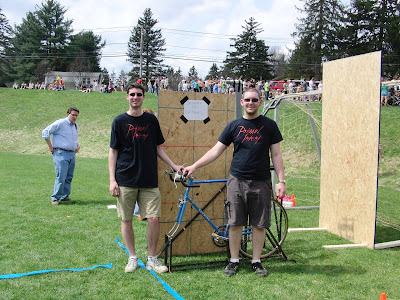 Left to Right : Steve Peifer & Jeffrey Ohliger
Now launching a hot dog is not as easy as it sounds. The item is delicate and must be prevented from breaking apart after launch. You have air resistance to tackle. No, the hot dogs cannot be encapsulated with fairings, neither can they be frozen. In fact, rules stated that all the hot dogs would be supplied on the day of the competition and would be of the same size and brand.
The rules also stated that the hot dog would be thrown in the direction of a straight line from the center of the launch site. Every inch it deviated from this line in either direction would be penalized from the distance you threw in the direction of the straight line. If the hot dog did split after launch, only the distance of the piece falling to the shortest distance in the direction of the straight line would be taken into account, no matter how far the other pieces went. Teams could be as big as 5 but only 2 people could be present at launch. The team with the greatest distance achieved would win a gift certificate of 75 dollars.
Interestingly, the pair came up with the idea of using pedal power to launch their hot dog. After lots of coin spent buying parts, welding and assembling, they had a working model. Off they went to the competition. At the end of the day, from 15 or 20 teams, their design achieved the best distance and they were proud winners. This, in spite of an unpredicted headwind straight from hell on that day.
Some days back, I caught up with Steve to help me unravel the mechanism behind the launcher. Enjoy the read, pictures and videos! Drop a comment if you have any questions.
Q. Steve, where did you pick this idea for your design? Did you consider any alternatives?
SP : The idea to build a centrifugal trebuchet came from high school when we built one for a Science Olympiad competition. The advantage of a centrifugal trebuchet is that it allows the object, in this case a hot dog, to be brought up to the desired launch speed slowly. This avoids extreme accelerations on the object which would have caused the hot dog to split and break. Our goal was to throw a hot dog completely unmodified (no freezing or encapsulating) over 350 feet, so there really weren't any other types of launchers (allowed in the rules) that would have thrown the dog at 150 mph without breaking it.
 The design
Q. That makes a lot of sense! Explain to readers how this mechanism operates.
SP : Sure. Its pedal powered, as you can see. We used a chain to couple the rear sprocket with the shaft of the rotating throwing arm. The person on the bicycle pedals until the desired launch speed is reached (there is a speedometer measuring the throwing arm tip speed). Then the launch is initiated by pulling a lever that releases a spring loaded rod that snaps into the path of the throwing arm. The rod strikes a pin attached to the hot dog holder. When they collide, the pin on the holder gets knocked off and allows the holder to open. The angular location of the launch mechanism (the spring loaded rod) sets the launch angle which can be adjusted in between launches.

 Hot dog holder
 Driven sprocket and shaft
 Bearings
Q. So was that your bike?
SP : No. It was my uncle's. Its an old clunker.

 Jeff, like a master, lays the torch to steel
Q. I'm sure the rules must have been a little tight. What, according to you, were some of the biggest challenges to overcome?
SP : Oh, there were many.
1) Air resistance, both for the hot dog and the throwing arm : In order to decrease the drag on the throwing arm, which was made out of square aluminum tube, we used foam to teardrop the throwing arm. This allowed us to increase the speed from around 90 mph to 160 mph.
2) Keeping the hot dog in one piece : Once we tweaked the release mechanism, this wasn't much of an issue with our design.
3) Making sure the hot dog is released at the optimum angle and not breaking anything during the launch : Initiating the launch at the desired angle wasn't hard, but making sure the hot dog didn't extrude out of the holder at high speed was a huge challenge. The more we secured the hot dog in place, the more likely the holder was to break during the launch. It took a lot of tweaking before we found a happy medium.
Q. I'm sure! So if you don't mind me asking, how did you go about calculating the effective range of the hot dog when launched?
SP : I created an Excel spreadsheet to calculate the required velocity of the hot dog so that it would reach our goal of 350 feet. The spreadsheet also calculated the energy required to power the launcher at that speed based on the physical properties of the throwing arm.


 Above are screenshots from Steve's Excel spreadsheet
Q. Interesting. I recall from Physics 101 that 45 degrees of launch angle gave you maximum launch range, but that didn’t take air resistance into account. You know, R = [(v)^2 x sin2(angle)]/g.
SP : Right, pretty much everything we learned in physics was for an ideal world with no air resistance. You are correct that 45 degrees gives max range with no air resistance. In the real world with our situation, we calculated that a launch angle of 35 degrees would do the trick.
Q. I'm sure you did a bunch of test runs before the big day. Just curious - how many hot dogs did that involve?
SP : You're right. We tested the launcher for a few weeks leading up to the competition in our backyard. Testing started off well right from the first launch. Our initial problems were with the hot dog breaking, but we eventually determined it was from a rubber band slicing through the dog as it left the holder. Once we got that issue fixed, we started throwing faster and faster. Each time we increased the speed, we had issues with the hot dog exiting the holder prematurely. We had to tweak the holder so that it required more force to open yet still open freely enough for a clean release without breaking anything. We probably threw about 40 hot dogs during testing.
 Steve pedals the launcher in his backyard
This video, shot at a high 420 fps, shows the launch sequence
Q. So the big day arrives. You guys do your thing. You win. Did your design actually work as planned?
SP : The design worked perfectly during the competition, just as it had during the testing that week. Unfortunately, we had no control over the wind which was blowing straight in our face at over 30 mph. We still won the competition, but we only threw a little over 290 feet compared to 400 feet during testing the day before (with no wind). To give an idea of how much the hot dog was blown off course, the head wind was coming at a slight angle, maybe 15 to 20 degrees from the right. To compensate, we had to launch about 100 feet to the right of our target, and the dog still blew back a couple feet left of center line!

This slow motion video captures the launch on the day of the competition.
Congratulations! Excellent work from you two!
A colleague of mine at work and a friend of his decided to team up for this serious challenge. Steve Peifer and Jeffrey Ohliger are both mechanical engineering alumni of Alfred University at Alfred, New York. Earlier this year, they found themselves wanting to compete in the school's 2009 Hot Launching Competition. The event would be held on April 26 in the University premises.
 Left to Right : Steve Peifer & Jeffrey Ohliger
Now launching a hot dog is not as easy as it sounds. The item is delicate and must be prevented from breaking apart after launch. You have air resistance to tackle. No, the hot dogs cannot be encapsulated with fairings, neither can they be frozen. In fact, rules stated that all the hot dogs would be supplied on the day of the competition and would be of the same size and brand.
The rules also stated that the hot dog would be thrown in the direction of a straight line from the center of the launch site. Every inch it deviated from this line in either direction would be penalized from the distance you threw in the direction of the straight line. If the hot dog did split after launch, only the distance of the piece falling to the shortest distance in the direction of the straight line would be taken into account, no matter how far the other pieces went. Teams could be as big as 5 but only 2 people could be present at launch. The team with the greatest distance achieved would win a gift certificate of 75 dollars.
Interestingly, the pair came up with the idea of using pedal power to launch their hot dog. After lots of coin spent buying parts, welding and assembling, they had a working model. Off they went to the competition. At the end of the day, from 15 or 20 teams, their design achieved the best distance and they were proud winners. This, in spite of an unpredicted headwind straight from hell on that day.
Some days back, I caught up with Steve to help me unravel the mechanism behind the launcher. Enjoy the read, pictures and videos! Drop a comment if you have any questions.
Q. Steve, where did you pick this idea for your design? Did you consider any alternatives?
SP : The idea to build a centrifugal trebuchet came from high school when we built one for a Science Olympiad competition. The advantage of a centrifugal trebuchet is that it allows the object, in this case a hot dog, to be brought up to the desired launch speed slowly. This avoids extreme accelerations on the object which would have caused the hot dog to split and break. Our goal was to throw a hot dog completely unmodified (no freezing or encapsulating) over 350 feet, so there really weren't any other types of launchers (allowed in the rules) that would have thrown the dog at 150 mph without breaking it.
 The design
Q. That makes a lot of sense! Explain to readers how this mechanism operates.
SP : Sure. Its pedal powered, as you can see. We used a chain to couple the rear sprocket with the shaft of the rotating throwing arm. The person on the bicycle pedals until the desired launch speed is reached (there is a speedometer measuring the throwing arm tip speed). Then the launch is initiated by pulling a lever that releases a spring loaded rod that snaps into the path of the throwing arm. The rod strikes a pin attached to the hot dog holder. When they collide, the pin on the holder gets knocked off and allows the holder to open. The angular location of the launch mechanism (the spring loaded rod) sets the launch angle which can be adjusted in between launches.

 Hot dog holder
 Driven sprocket and shaft
 Bearings
Q. So was that your bike?
SP : No. It was my uncle's. Its an old clunker.

 Jeff, like a master, lays the torch to steel
Q. I'm sure the rules must have been a little tight. What, according to you, were some of the biggest challenges to overcome?
SP : Oh, there were many.
1) Air resistance, both for the hot dog and the throwing arm : In order to decrease the drag on the throwing arm, which was made out of square aluminum tube, we used foam to teardrop the throwing arm. This allowed us to increase the speed from around 90 mph to 160 mph.
2) Keeping the hot dog in one piece : Once we tweaked the release mechanism, this wasn't much of an issue with our design.
3) Making sure the hot dog is released at the optimum angle and not breaking anything during the launch : Initiating the launch at the desired angle wasn't hard, but making sure the hot dog didn't extrude out of the holder at high speed was a huge challenge. The more we secured the hot dog in place, the more likely the holder was to break during the launch. It took a lot of tweaking before we found a happy medium.
Q. I'm sure! So if you don't mind me asking, how did you go about calculating the effective range of the hot dog when launched?
SP : I created an Excel spreadsheet to calculate the required velocity of the hot dog so that it would reach our goal of 350 feet. The spreadsheet also calculated the energy required to power the launcher at that speed based on the physical properties of the throwing arm.


 Above are screenshots from Steve's Excel spreadsheet
Q. Interesting. I recall from Physics 101 that 45 degrees of launch angle gave you maximum launch range, but that didn’t take air resistance into account. You know, R = [(v)^2 x sin2(angle)]/g.
SP : Right, pretty much everything we learned in physics was for an ideal world with no air resistance. You are correct that 45 degrees gives max range with no air resistance. In the real world with our situation, we calculated that a launch angle of 35 degrees would do the trick.
Q. I'm sure you did a bunch of test runs before the big day. Just curious - how many hot dogs did that involve?
SP : You're right. We tested the launcher for a few weeks leading up to the competition in our backyard. Testing started off well right from the first launch. Our initial problems were with the hot dog breaking, but we eventually determined it was from a rubber band slicing through the dog as it left the holder. Once we got that issue fixed, we started throwing faster and faster. Each time we increased the speed, we had issues with the hot dog exiting the holder prematurely. We had to tweak the holder so that it required more force to open yet still open freely enough for a clean release without breaking anything. We probably threw about 40 hot dogs during testing.
 Steve pedals the launcher in his backyard
This video, shot at a high 420 fps, shows the launch sequence
Q. So the big day arrives. You guys do your thing. You win. Did your design actually work as planned?
SP : The design worked perfectly during the competition, just as it had during the testing that week. Unfortunately, we had no control over the wind which was blowing straight in our face at over 30 mph. We still won the competition, but we only threw a little over 290 feet compared to 400 feet during testing the day before (with no wind). To give an idea of how much the hot dog was blown off course, the head wind was coming at a slight angle, maybe 15 to 20 degrees from the right. To compensate, we had to launch about 100 feet to the right of our target, and the dog still blew back a couple feet left of center line!

This slow motion video captures the launch on the day of the competition.
Congratulations! Excellent work from you two!
* * *
Friday, May 15, 2009
Conversations With David Gordon Wilson : Part V
Here is the final installment in my phone conversation with Prof. David Gordon Wilson, author of Bicycling Science. Here, he narrows down his views on a handful of important topics : art and bicycle design, the helmet debate, bicycles in formal education, environmental issues, and a few ideas on a "progressive taxation" policy. Enjoy.
Q. Earlier we talked about how the bicycle, although a very stable design refined over the years, could use smaller improvements. But a handful of folks also imagine very radical designs altogether. We live in the internet age, and every so often now, we find some 'designer' coming out with an odd looking bike that has no practical value. Am I missing something? I guess what I'm trying to ask is should critics of such works forget about practicality and focus on the fun in the art?
DGW : Obviously, this isn't something that has begun now. Yes, we have had some impractical designs over the years that never made it. But personally, I have nothing against artistic designers. In fact, one year, when I was judge at the International Bicycle Design Competition in Taiwan, I noticed many of the designs actually came from artists. Sometimes, they can produce a good design. For example, take Sam Whittingham's Varna Diablo or Fred Markham's Varna Mephisto as examples. Both broke speed records and were designed by one man - Georgi Georgiev, who happened to study art and is an architect.
 Georgi Georgiev, picture courtesy Varna Handcycles
I wouldn’t want to stifle innovation, but I wish there was much more attention to doing something about the many life-threatening problems with bikes. I’m about to write to the bicycle-safety person on the CPSC, the principal government watch-dog on the subject, to find why my earnest and expensive testimony on the topic last year has apparently been totally ignored. I hope that he tells me that something is happening, in which case I’ll let you know.
Q. One of the longest running debates in the world of cycling happens to be that of helmet wearing and its benefits vs the harm they cause indirectly. Its a topic that often polarizes people. Where do you stand in this debate?
DGW : Well Ron, if you're asking me whether I support mandatory helmet laws, the answer is no. I don't think anyone must be forced to place a lid on their heads. But I don't like my insurance money going to idiots who get injured and are now vegetables in hospitals because they didn't choose to wear one. That is ridiculous.
Q. ....Right. But what of the people who decry the use of helmets? Many at times, I find they base their views on statistics and you know, some sort of 'research' done by professionals in other countries. Among the most prominent studies were these Australian ones that showed how mandatory helmet legislation back in 1990's decreased the number of bicyclists on the road in the following years....
DGW : ....They are statistically incorrect.
Q. Another popular one seems to be that helmet wearing actually increases the number of injuries.
DGW : That's stupid. Its like saying that uniformed soldiers who go to war wearing helmets get injured more because they wore a helmet. Of course they got injured more. They went to war and got shot at! The others did not. They sat at home.
Besides, helmets not only protect you while you're riding but also when you're not. I remember an incident that happened with me not so long ago. I was at this busy intersection walking my bike. For some reason or the other, I felt a little heavy in the head..you know...a dizziness. A little later, I fell onto the road. I didn't get too hurt. If I weren't wearing a helmet, I'd imagine something worse would have happened to me. Its desirable that cyclists wear helmets. But there are one or two everywhere who oppose it. Once, I visited Adelaide to present a topic on bicycling safety. The reception was very negative. These people aren't ready to understand the benefits of helmets for their own sake and the sake of others. Talk about the costs of hospitalization that others have to shoulder! Its not pleasing. I believe helmet wearing has a strong benefit-cost ratio, both for the wearer and to others in society.
Q. What courses did you teach at MIT?
DGW : I joined the faculty in 1966. I taught turbine design, heat transfer, thermodynamics, and the senior course 2.70.
Q. I think you can learn a lot of science and engineering from bicycles. Do you support using the bicycle as a platform for such an initiative?
DGW : Oh sure. I often did that in 2.70, asking students to improve some aspect or another of bicycles as projects. Frank Whitt supported that idea too, I believe.
Q. Really?
DGW : Well yes. He proposed that physics experiments be taught in schools and colleges using bicycles. I thought it was a good idea.
Q. Let's switch gears, Dave. The environment. Do you believe in Global Warming?
DGW : Oh yes.
Q. There sure is something about this issue that raises skeptics among people? I guess its happening in the world, but its not an "in-your-face" thing.
DGW : Well, that's what the Bush Administration did. They stifled the issue in front of the public. They also refused to endorse the Kyoto Accords because to do so would threaten the "American way of life". The cliff may not be seen now, but when it does arrive, it'll be too late to go back. Its a big plunge from there.
The issue is real and a number of people have written on it. Recently, I read Jared Diamond's book Collapse : How Societies Choose To Fail Or Succeed....
Q. ....The Pulitzer prize winning author..
DGW : Yes. And in it, he describes the massive deforestation that took place in Easter Island. Infact, he writes that the society collapsed entirely due to the environmental damage. Same goes for the Greenland Norse, the Mayans of Central America, the Polynesians of Pitcairn Island. Environmental damage slowly kill societies.

Q. I came across one of your energy policy proposals online on your website. In it, you write that engineers should take responsibility for the energy crisis...
DGW : Oh no.. at the time I wrote it, it was sort of a joke. Anyway, they do have a role to play no doubt. Civil engineers created construction systems, transportation systems, and water-supply and sanitation systems that enabled us to live in great cities. Mining engineers enabled vast quantities of coal, oil and gas to be delivered to factories and to our homes. Mechanical engineers invented steam engines, railroads, turbines, oil-field equipment, internal-combustion engines, automobiles, airplanes, and the means of producing these so inexpensively that we all feel that we have a God-given right to own and use lots of everything. Chemical engineers devised means of refining petroleum and gas fuels to drive all these types of power producers. Electrical engineers developed alternators and means for delivering electric power to us all, and information systems that, while entrancing us and bringing us closer together, increase the demand for goods and services and for ever-more travel.
Q. You also propose a "progressive taxation" policy.
DGW : Yes. Personally as an engineer, I like to come up with sound decisions that affect policy. You can read most of my ideas in the proposal. What irritates me is that no one has taken an interest to publish it. I proposed to MIT to have this out as a news release and they gave me a cold shoulder. Hopefully, I'll get more people to take interest in it.
Q. Perhaps I could do my part through my blog....
Q. David, I've had a wonderful time chatting with you on these topics. Its going to be memorable. You certainly have some sound ideas and I really hope that more people would know you, not just as a name behind Bicycling Science, but as a person. Good luck with your health, Wilson Turbopower and MIT.
DGW : Its my pleasure. Thank you, Ron.
Q. Earlier we talked about how the bicycle, although a very stable design refined over the years, could use smaller improvements. But a handful of folks also imagine very radical designs altogether. We live in the internet age, and every so often now, we find some 'designer' coming out with an odd looking bike that has no practical value. Am I missing something? I guess what I'm trying to ask is should critics of such works forget about practicality and focus on the fun in the art?
DGW : Obviously, this isn't something that has begun now. Yes, we have had some impractical designs over the years that never made it. But personally, I have nothing against artistic designers. In fact, one year, when I was judge at the International Bicycle Design Competition in Taiwan, I noticed many of the designs actually came from artists. Sometimes, they can produce a good design. For example, take Sam Whittingham's Varna Diablo or Fred Markham's Varna Mephisto as examples. Both broke speed records and were designed by one man - Georgi Georgiev, who happened to study art and is an architect.
 Georgi Georgiev, picture courtesy Varna Handcycles
I wouldn’t want to stifle innovation, but I wish there was much more attention to doing something about the many life-threatening problems with bikes. I’m about to write to the bicycle-safety person on the CPSC, the principal government watch-dog on the subject, to find why my earnest and expensive testimony on the topic last year has apparently been totally ignored. I hope that he tells me that something is happening, in which case I’ll let you know.
Q. One of the longest running debates in the world of cycling happens to be that of helmet wearing and its benefits vs the harm they cause indirectly. Its a topic that often polarizes people. Where do you stand in this debate?
DGW : Well Ron, if you're asking me whether I support mandatory helmet laws, the answer is no. I don't think anyone must be forced to place a lid on their heads. But I don't like my insurance money going to idiots who get injured and are now vegetables in hospitals because they didn't choose to wear one. That is ridiculous.
Q. ....Right. But what of the people who decry the use of helmets? Many at times, I find they base their views on statistics and you know, some sort of 'research' done by professionals in other countries. Among the most prominent studies were these Australian ones that showed how mandatory helmet legislation back in 1990's decreased the number of bicyclists on the road in the following years....
DGW : ....They are statistically incorrect.
Q. Another popular one seems to be that helmet wearing actually increases the number of injuries.
DGW : That's stupid. Its like saying that uniformed soldiers who go to war wearing helmets get injured more because they wore a helmet. Of course they got injured more. They went to war and got shot at! The others did not. They sat at home.
Besides, helmets not only protect you while you're riding but also when you're not. I remember an incident that happened with me not so long ago. I was at this busy intersection walking my bike. For some reason or the other, I felt a little heavy in the head..you know...a dizziness. A little later, I fell onto the road. I didn't get too hurt. If I weren't wearing a helmet, I'd imagine something worse would have happened to me. Its desirable that cyclists wear helmets. But there are one or two everywhere who oppose it. Once, I visited Adelaide to present a topic on bicycling safety. The reception was very negative. These people aren't ready to understand the benefits of helmets for their own sake and the sake of others. Talk about the costs of hospitalization that others have to shoulder! Its not pleasing. I believe helmet wearing has a strong benefit-cost ratio, both for the wearer and to others in society.
Q. What courses did you teach at MIT?
DGW : I joined the faculty in 1966. I taught turbine design, heat transfer, thermodynamics, and the senior course 2.70.
Q. I think you can learn a lot of science and engineering from bicycles. Do you support using the bicycle as a platform for such an initiative?
DGW : Oh sure. I often did that in 2.70, asking students to improve some aspect or another of bicycles as projects. Frank Whitt supported that idea too, I believe.
Q. Really?
DGW : Well yes. He proposed that physics experiments be taught in schools and colleges using bicycles. I thought it was a good idea.
Q. Let's switch gears, Dave. The environment. Do you believe in Global Warming?
DGW : Oh yes.
Q. There sure is something about this issue that raises skeptics among people? I guess its happening in the world, but its not an "in-your-face" thing.
DGW : Well, that's what the Bush Administration did. They stifled the issue in front of the public. They also refused to endorse the Kyoto Accords because to do so would threaten the "American way of life". The cliff may not be seen now, but when it does arrive, it'll be too late to go back. Its a big plunge from there.
The issue is real and a number of people have written on it. Recently, I read Jared Diamond's book Collapse : How Societies Choose To Fail Or Succeed....
Q. ....The Pulitzer prize winning author..
DGW : Yes. And in it, he describes the massive deforestation that took place in Easter Island. Infact, he writes that the society collapsed entirely due to the environmental damage. Same goes for the Greenland Norse, the Mayans of Central America, the Polynesians of Pitcairn Island. Environmental damage slowly kill societies.

Q. I came across one of your energy policy proposals online on your website. In it, you write that engineers should take responsibility for the energy crisis...
DGW : Oh no.. at the time I wrote it, it was sort of a joke. Anyway, they do have a role to play no doubt. Civil engineers created construction systems, transportation systems, and water-supply and sanitation systems that enabled us to live in great cities. Mining engineers enabled vast quantities of coal, oil and gas to be delivered to factories and to our homes. Mechanical engineers invented steam engines, railroads, turbines, oil-field equipment, internal-combustion engines, automobiles, airplanes, and the means of producing these so inexpensively that we all feel that we have a God-given right to own and use lots of everything. Chemical engineers devised means of refining petroleum and gas fuels to drive all these types of power producers. Electrical engineers developed alternators and means for delivering electric power to us all, and information systems that, while entrancing us and bringing us closer together, increase the demand for goods and services and for ever-more travel.
Q. You also propose a "progressive taxation" policy.
DGW : Yes. Personally as an engineer, I like to come up with sound decisions that affect policy. You can read most of my ideas in the proposal. What irritates me is that no one has taken an interest to publish it. I proposed to MIT to have this out as a news release and they gave me a cold shoulder. Hopefully, I'll get more people to take interest in it.
Q. Perhaps I could do my part through my blog....
DGW : ..Maybe you can!
Q. David, I've had a wonderful time chatting with you on these topics. Its going to be memorable. You certainly have some sound ideas and I really hope that more people would know you, not just as a name behind Bicycling Science, but as a person. Good luck with your health, Wilson Turbopower and MIT.
DGW : Its my pleasure. Thank you, Ron.
* * *
Prof. David Gordon Wilson has written an energy proposal and a progressive taxation policy to go with it, on his website. He calls it "an innovative policy producing incentives for reducing the use of nonrenewable energy, of resources, and of polluting emissions, and which simultaneously increases employment, reduces poverty, and discourages illegal immigration."
It is a must read for anyone interesting in some stimulating ideas for our times. This, from a world renowned engineer, cyclist and author of Bicycling Science. Thanks for reading!
CONNECTED READINGS :
Conversations With David Gordon Wilson : Part I
Conversations With David Gordon Wilson : Part II
Conversations With David Gordon Wilson : Part III
Conversations With David Gordon Wilson : Part IV
Conversations With David Gordon Wilson : Part V
Statisculation And Sporting Prejudice In Anti-Helmet Propaganda
The Design Of Advanced Human-Powered Vehicles/Velomobiles And Product-Liability Litigation : Can They Co-exist In The Light Of Apparently Outrageous US Cases?
Prof. David Gordon Wilson has written an energy proposal and a progressive taxation policy to go with it, on his website. He calls it "an innovative policy producing incentives for reducing the use of nonrenewable energy, of resources, and of polluting emissions, and which simultaneously increases employment, reduces poverty, and discourages illegal immigration."
It is a must read for anyone interesting in some stimulating ideas for our times. This, from a world renowned engineer, cyclist and author of Bicycling Science. Thanks for reading!
CONNECTED READINGS :
Conversations With David Gordon Wilson : Part I
Conversations With David Gordon Wilson : Part II
Conversations With David Gordon Wilson : Part III
Conversations With David Gordon Wilson : Part IV
Conversations With David Gordon Wilson : Part V
Statisculation And Sporting Prejudice In Anti-Helmet Propaganda
The Design Of Advanced Human-Powered Vehicles/Velomobiles And Product-Liability Litigation : Can They Co-exist In The Light Of Apparently Outrageous US Cases?
* * *
Subscribe to:
Posts (Atom)


